AHU vs FCU: Differences, Uses and Which One You Need
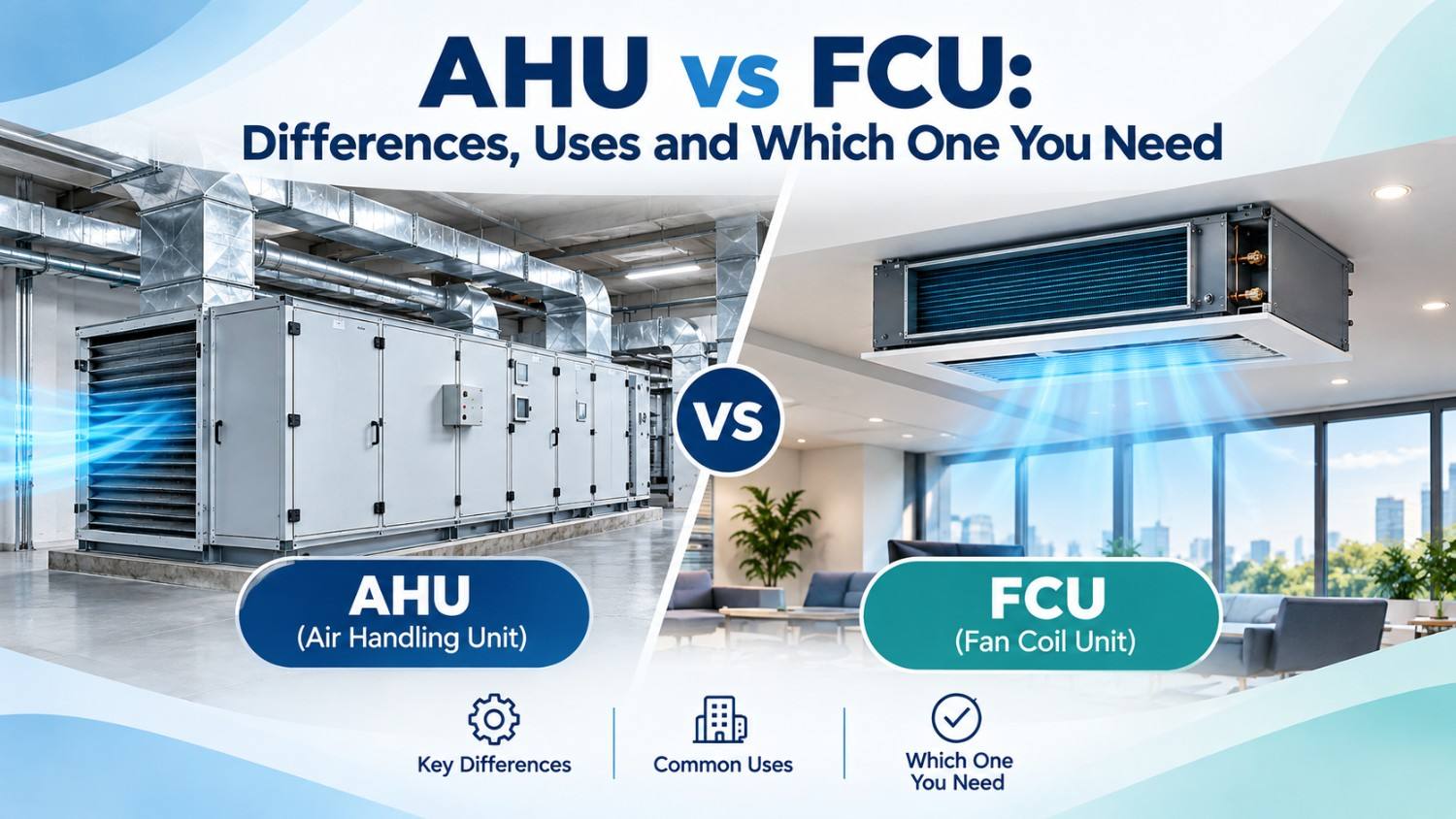
Walk into any hospital, mall or office tower and you are breathing air that a machine has already worked on. Two of the most common machines behind that air are the air handling unit (AHU) and the fan coil unit (FCU). They look different, they cost different amounts, and they solve different problems, yet people mix them up all the time.
If you are planning an HVAC system, or just trying to understand a quotation, this guide explains what each unit does, where it fits, and how to decide between them.
What Is an Air Handling Unit AHU?
An Air handling unit is a large central machine that conditions air for a whole building or a big zone. Inside a double-skin casing you will find a fan, cooling and sometimes heating coils, filters, dampers and often a humidity control section. The AHU pulls in return air, fresh air or a mix of both, cleans it, brings it to the right temperature and moisture level, and pushes it through ducts to the rooms it serves.
The big advantage is control. An AHU can handle high air volumes and fine filtration, so it is the standard choice where air quality matters as much as comfort. Treated fresh air units (TFA/FAU) are a special type that condition 100 percent outside air before it enters the building, which is common in IT parks, pharma plants and hospitals.
AHUs come in several formats. Floor-mounted units suit plant rooms and heavy duty jobs. Vertical units save floor space. Ceiling suspended units fit where headroom is tight, and ranges like 700 to 12,000 CFM cover most commercial needs.
What Is a Fan Coil Unit FCU?
A Fan coil unit is a small, room-level device. It has three basic parts: a fan, a coil and a filter. Chilled or hot water from a central plant flows through the coil, the fan blows room air across it, and the air comes out cooler or warmer. There is no refrigeration cycle inside the unit itself.
An FCU does not bring in much fresh air and it does not filter as finely as an AHU. What it does well is give each room its own temperature control. Switch it off in an empty hotel room and you stop spending energy there.
AHU vs FCU: The Main Differences
| Factor | AHU | FCU |
| Size | Large, central equipment | Small, room-level unit |
| Coverage | Entire floor, wing or building | Single room or small zone |
| Air delivery | Through ductwork | Directly into the room, or short ducts |
| Fresh air handling | Strong, can treat 100% fresh air | Limited, needs separate fresh air supply |
| Filtration | Multi-stage, fine filters possible | Basic filter |
| Humidity control | Good, especially with dehumidification sections | Limited |
| Individual room control | Zone-level | Room-level |
| Installation | Plant room or large ceiling space, ducting needed | Easy, minimal space |
| Typical cost | Higher upfront | Lower per unit |
The simplest way to remember it: an AHU treats the air, an FCU tops up the temperature in a room.
Where Each One Is Used
AHUs work best in:
- Hospitals and operation theatres
- Pharmaceutical and food plants
- Clean rooms and labs
- IT parks and data-sensitive spaces
- Malls, airports and auditoriums
- Any building that needs large fresh air volumes or strict humidity control
FCUs work best in:
- Hotel rooms and guest suites
- Individual offices and meeting rooms
- Hospital wards where each room needs its own setting
- Residential and small commercial spaces
Cost and Maintenance
An AHU costs more to buy and install. You need a plant room or a generous ceiling void, ductwork, and a chilled water or DX supply. Running costs depend on how well the system is balanced, but a properly designed unit with the right coil and fan efficiency is economical for the volume of air it moves. Maintenance involves filter changes, coil cleaning, belt or motor checks and damper inspection.
An FCU is cheaper per unit and quicker to fit, but you may need dozens of them in a large building. Each one has its own filter and condensate drain, which means more small service points. Clogged drain pans and dirty filters are the usual complaints.
Coil quality matters for both. Hydrophilic fin coils, for example, drain condensate better and resist corrosion, which is useful in humid or coastal locations.
Can You Use Both Together?
Yes, and many modern buildings do. A common setup uses a treated fresh air AHU to bring in clean, dehumidified outside air at the right quantity, while FCUs in each room handle the remaining cooling load. This splits the job sensibly. The AHU takes care of ventilation and moisture, and the FCUs deal with room-by-room comfort.
This combination is popular in hotels, offices and hospitals because it keeps air quality high without forcing one big system to do everything.
How to Choose Between AHU and FCU
Start with these questions:
- How big is the space? Large areas with high airflow needs lean toward an AHU. Small rooms suit an FCU.
- How important is air quality? If you need fine filtration, controlled humidity or pressure control, choose an AHU.
- Do occupants need individual control? If yes, FCUs give that flexibility.
- What is your fresh air requirement? Heavy fresh air demand points to an AHU or a treated fresh air unit.
- What does your budget allow? FCUs have a lower entry cost for small projects. AHUs make more sense as the building and its requirements grow.
- Is there space for ducts and a plant room? If not, FCUs or compact ceiling suspended AHU’s may be the practical answer.
When the requirements are mixed, a combined system is usually the right answer. A site visit and a load calculation will settle it faster than guesswork.
Final Thoughts
AHU and FCU are not rivals so much as tools for different jobs. The AHU handles air at scale, with filtration, fresh air and humidity under control. The FCU gives you simple, local comfort. Picking the right one, or the right pair, depends on your building type, air quality needs and budget.
At Airtree, we manufacture air handling units in floor mounted, vertical and ceiling suspended designs, along with fan coil units, Chilled water and DX cooling coils, and treated fresh air units. If you are not sure which fits your project, our engineers can help you size and specify it. Browse the range at airtreehvac.com/products or reach us through the contact page.
Frequently Asked Questions
What is the main difference between an AHU and an FCU?
An AHU is a large central unit that filters, cools, heats and sometimes dehumidifies air for a whole zone or building and sends it through ducts. An FCU is a small room-level unit that uses a fan and a water coil to heat or cool one space.
Which is more energy efficient, AHU or FCU?
It depends on the building. FCUs save energy in spaces that are often empty, since each room can be switched off. AHUs are efficient for moving large air volumes and recovering energy when paired with the right coils and controls. Good design matters more than the unit type.
Can an FCU replace an AHU?
Not where fresh air, fine filtration or humidity control are important. An FCU only conditions the air already in the room, so it cannot do the ventilation work of an AHU. For small spaces with low fresh air needs, an FCU may be enough.
Do AHU and FCU need a chiller?
Both usually run on chilled water from a central chiller. An AHU can also use a DX coil, which cools air directly with refrigerant instead of chilled water.
Which is better for hospitals and pharma plants?
AHUs, because these facilities need filtered, controlled air with strict humidity and pressure requirements. FCUs are sometimes added in wards or offices for extra local temperature control.
How often should AHUs and FCUs be serviced?
Filters should be checked monthly and replaced as needed. Coils, drain pans, fans and motors should get a full inspection at least once or twice a year, more often in dusty or humid environments.
Stay ahead with more industry insights
Join our newsletter to receive the latest HVAC technologies and ventilation solutions directly in your inbox.