Air Washer vs Evaporative Cooler vs AHU: Which Cooling System Suits Indian Industries
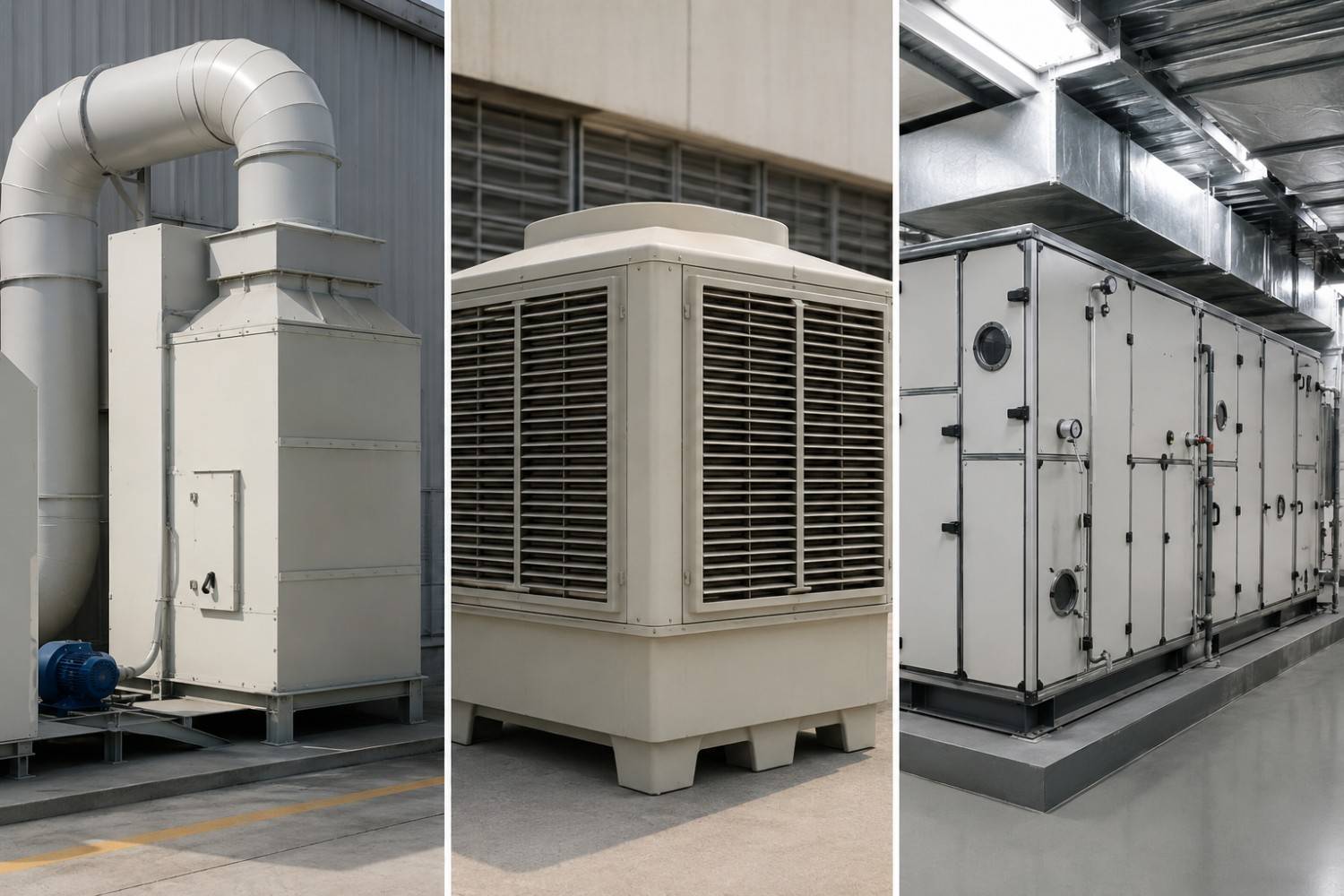
Walk into any large Indian industrial facility — a textile mill in Surat, an auto-parts plant in Pune, or a food-processing unit in UP — and the first thing you notice is the heat. Managing that heat is not just a matter of worker comfort; it directly affects productivity, product quality, machinery lifespan, and regulatory compliance.
Three systems come up most often in conversations about industrial cooling: air washers, evaporative coolers, and air handling units (AHUs). Each one serves a distinct purpose, and picking the wrong one for your facility is an expensive mistake.
At Airtree, we have worked with plant managers, industrial engineers, and facility heads across India to design and install the right ventilation and cooling solutions. This guide draws on that experience to give you a clear, practical comparison — without the jargon.
What Is an Air Washer?
An Air Washer is an industrial air treatment system that simultaneously cools, humidifies, and cleans incoming air. Hot outdoor air passes through a chamber fitted with water spray nozzles arranged in multiple banks. As air travels through this water curtain, three things happen at once: temperature drops through evaporative cooling, airborne dust and particulate matter get scrubbed out, and humidity rises to a desired level.
How it works in simple terms: Think of it as a shower for air. The water washes out pollutants while the evaporation process pulls heat away from the airstream.
Where Air Washers Work Best
- Textile spinning and weaving mills (yarn quality depends on controlled humidity)
- Paper and cardboard manufacturing
- Tobacco processing facilities
- Pharmaceutical raw-material handling zones
- Foundries and casting shops with heavy airborne dust loads
Key Advantages of Air Washers
- Simultaneous cooling, humidification, and filtration in one unit
- Handles high dust and particulate loads efficiently
- Relatively lower operating cost compared to refrigerant-based systems
- Delivers large volumes of treated air across wide factory floors
- Long operational life when maintained properly
Limitations
- Requires a reliable water supply and a water treatment arrangement
- Regular cleaning of spray nozzles, eliminators, and sump is non-negotiable
- Not suitable for applications that require dehumidification
- Performance is sensitive to the ambient wet-bulb temperature
What Is an Evaporative Cooler?
An Evaporative Cooler — often called a desert cooler or swamp cooler at a smaller scale — works on a straightforward principle: when water evaporates, it absorbs heat from the surrounding air. In an industrial evaporative cooler, a high-volume fan draws hot outside air through water-saturated cellulose or rigid media pads. The air loses heat as the water on the pads evaporates, and the cooled air is then supplied into the workspace.
Unlike an air washer, an evaporative cooler does not spray water directly into the airstream. The cooling happens through the media, so there is no risk of water droplets entering the workspace.
Where Evaporative Coolers Work Best
- Warehouses and logistics facilities
- Metal fabrication shops and welding bays
- Large open workshops
- Agricultural storage and processing sheds
- Spot-cooling applications in factories with heat-generating machinery
- Any large space that operates with open doors or natural ventilation
Key Advantages of Evaporative Coolers
- Very low energy consumption — typically 75–80% less than a refrigerated system of equivalent capacity
- Simple installation with minimal civil work
- Low capital cost, making it accessible for small and mid-sized facilities
- Adds moisture to dry air, which benefits workers and certain materials
- Effective in hot, dry climates — exactly the conditions across most of northern and central India
Limitations
- Effectiveness drops significantly in high-humidity conditions (monsoon months in coastal areas)
- Does not filter air to the same extent as an air washer
- Cannot achieve the precise temperature and humidity control that sensitive processes demand
- Adds moisture continuously, which can be a drawback in certain storage environments
What Is an Air Handling Unit (AHU)?
An Air Handling Unit AHU is the central component of a mechanical HVAC system. Rather than relying solely on evaporation, an AHU conditions air through a combination of processes — filtering, cooling or heating via a refrigerant-charged coil or chilled water coil, humidifying or dehumidifying, and then distributing conditioned air through a duct network.
AHUs are the backbone of precision climate control. They can maintain exact temperature and relative humidity levels regardless of outdoor conditions, which is why they are found in cleanrooms, hospitals, server rooms, and high-end manufacturing environments.
Where AHUs Work Best
- Pharmaceutical manufacturing (GMP-compliant environments)
- Electronics and semiconductor manufacturing
- Automobile paint shops (temperature and humidity affect finish quality)
- Food and beverage processing units with strict hygiene standards
- Data centers and server rooms
- Commercial spaces integrated into industrial campuses
Key Advantages of AHUs
- Precise, year-round temperature and humidity control
- Works effectively regardless of outdoor weather conditions
- Advanced filtration options (including HEPA and MERV-rated filters)
- Scalable and customizable — coils, fans, dampers, and controls can be tailored to exact requirements
- Integrates with Building Management Systems (BMS) for automated control
Limitations
- Significantly higher capital cost than evaporative solutions
- Higher energy consumption (especially in refrigerant-based systems)
- Requires skilled installation, commissioning, and maintenance
- Chilled water systems need a dedicated chiller plant, adding to infrastructure cost
Side-by-Side Comparison: Air Washer vs Evaporative Cooler vs AHU
| Parameter | Air Washer | Evaporative Cooler | AHU |
| Cooling Mechanism | Evaporation + water spray | Evaporation through media pads | Refrigerant / chilled water coil |
| Air Filtration | High (washes particulates) | Moderate | High (with appropriate filters) |
| Humidity Control | Adds humidity | Adds humidity | Adds or removes humidity |
| Energy Consumption | Low–Medium | Low | Medium–High |
| Capital Cost | Medium | Low | High |
| Best Climate | Hot & dry to moderate | Hot & dry | All climates |
| Precision Control | Limited | Limited | High |
| Ideal Application | Textile, paper, foundry | Warehouses, workshops | Pharma, electronics, clean rooms |
| Water Requirement | High | Moderate | Low (for chilled water systems) |
| Maintenance Complexity | Medium (sump, nozzles) | Low (media replacement) | Medium–High (refrigerant, controls) |
How India's Climate Should Shape Your Decision
India is not a single climate zone. The conditions in Rajasthan are fundamentally different from those in Mumbai or Chennai, and that difference matters enormously when selecting a cooling system.
Hot and dry regions (Rajasthan, Gujarat, parts of MP and UP): Evaporative coolers and air washers perform at their peak here. The low ambient humidity means evaporation is highly effective, and temperature drops of 10–15°C are regularly achieved. For general industrial spaces and warehouses in these zones, evaporative cooling is the most cost-efficient choice.
Humid coastal regions (Mumbai, Chennai, Kerala, West Bengal): During monsoon months, outdoor relative humidity routinely exceeds 80–90%, and evaporative systems lose much of their effectiveness. If you are in a coastal industrial cluster and need reliable year-round comfort or process control, an AHU-based system becomes a more dependable investment despite the higher cost.
Mixed climates (Pune, Hyderabad, Bangalore, Delhi NCR): These cities experience pronounced dry summers followed by humid monsoons. A combination approach often makes the most sense — evaporative cooling for the dry months and mechanical cooling capability for peak humidity periods. Airtree's engineering team regularly designs hybrid systems for facilities in these zones.
How Airtree Approaches Industrial Cooling
At Airtree, we do not believe in one-size-fits-all solutions. Every facility has its own process requirements, budget constraints, and local climate conditions. Our approach begins with a site assessment where we measure ambient conditions, map heat load distribution, evaluate existing ventilation, and understand the process sensitivity of your operations.
From there, we engineer a system — whether that is a standalone air washer, a fleet of industrial evaporative coolers, a custom AHU, or a combination of these — that delivers the right result for your specific situation. You can explore our full range of industrial cooling and ventilation products at airtreehvac.com/products.
Frequently Asked Questions (FAQs)
Q1. Can I use an evaporative cooler in a factory that also operates during the monsoon season?
Evaporative coolers work best when outdoor relative humidity is below 60–65%. During peak monsoon months in humid climates, their cooling efficiency drops noticeably. If your facility must maintain comfortable conditions year-round, consider a hybrid setup or an AHU-based system. Airtree can evaluate your specific location and recommend the right configuration.
Q2. Is an air washer the same as an evaporative cooler?
They share the same fundamental principle — evaporative cooling — but they operate differently. An air washer sprays water directly into the airstream through nozzle banks, which also washes out dust and particulate matter from the air. An evaporative cooler passes air through wet media pads; water does not enter the airstream directly. Air washers are better suited for dusty or high-particulate environments and offer stronger air-cleaning capability.
Q3. How much energy does an industrial evaporative cooler save compared to a conventional AC system?
In suitable dry-heat conditions, an industrial evaporative cooler typically consumes 70–80% less electricity than a refrigerant-based air conditioning system of equivalent capacity. The exact saving depends on outdoor conditions, insulation of the facility, and the specific equipment selected.
Q4. What is the typical maintenance schedule for an air washer?
An air washer requires weekly inspection of spray nozzles and water eliminators, monthly cleaning of the sump and water distribution system, and periodic inspection of the fan, motor, and belt drives. Water quality management — including treatment to prevent scaling and biological growth — is critical to long-term performance.
Q5. Can an AHU be installed in a factory that does not have a chiller plant?
Yes. AHUs can be configured with direct expansion (DX) coils connected to outdoor condensing units, eliminating the need for a central chiller. This is a common and practical approach for medium-sized industrial and commercial spaces. Airtree offers both chilled water and DX-based AHU solutions.
Q6. Which cooling system is best for a pharmaceutical manufacturing plant in India?
Pharmaceutical manufacturing typically requires precise temperature and humidity control to meet GMP guidelines — conditions that evaporative systems cannot reliably deliver. An AHU with appropriate filtration (often HEPA or EU-rated filters), humidity control, and redundancy is the standard choice for pharma environments. Airtree has experience designing systems for GMP-compliant facilities.
Q7. Does Airtree provide site assessments before recommending a system?
Yes. Our team conducts detailed site assessments covering ambient conditions, heat load analysis, process requirements, and space constraints before recommending any solution. Contact us through our website airtreehvac.com to schedule a consultation.
Final Thoughts
There is no universal answer to the air washer vs evaporative cooler vs AHU question. The right system depends on what your process demands, where in India your facility is located, what your budget allows, and what level of control you need. What is universally true is this: an undersized or incorrectly chosen cooling system costs more in the long run — through energy waste, lost productivity, product quality failures, and premature equipment breakdown — than the premium paid for a properly engineered solution upfront.
Airtree exists to help Indian industries make that engineering decision with confidence. Whether you are setting up a greenfield facility, upgrading an aging system, or troubleshooting an underperforming installation, our team brings the technical depth and field experience to get it right.
Explore our product range at airtreehvac.com/products or reach out to our team directly through airtreehvac.com.
Stay ahead with more industry insights
Join our newsletter to receive the latest HVAC technologies and ventilation solutions directly in your inbox.