Basement Ventilation System: Complete Guide for Commercial Buildings
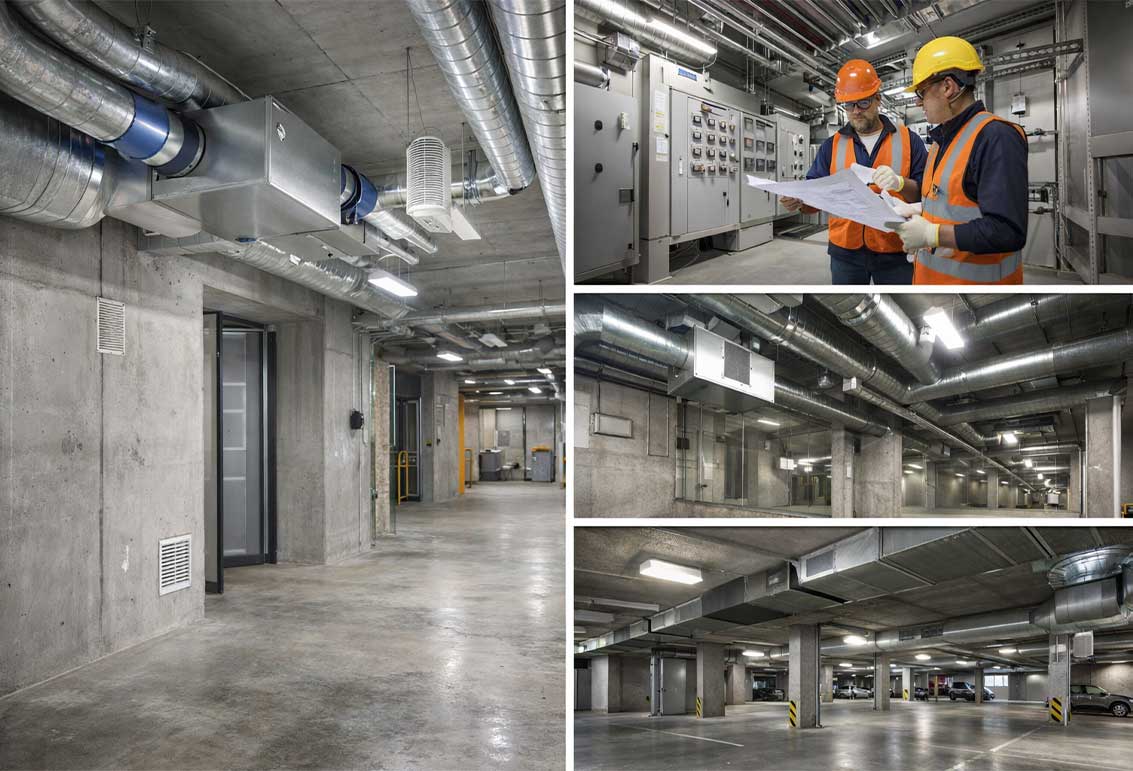
A poorly ventilated basement is one of the most overlooked — and costly — oversights in commercial building management. Carbon monoxide from vehicles, humidity from concrete, heat from electrical panels, and stale air from utility rooms can create a dangerous environment that violates safety codes and damages your building's structure and equipment. This guide covers everything a facility manager, building owner, or HVAC decision-maker needs to know about basement ventilation systems for commercial buildings: how they work, the different types available, Indian compliance requirements, and how to select the right system for your specific use case.
Quick Answer: A basement ventilation system mechanically circulates fresh air into enclosed basement spaces while removing stale, humid, or contaminated air. For commercial basements — especially car parks — it is both a safety requirement and a regulatory mandate under the National Building Code (NBC) 2016.
Why Basement Ventilation Is Critical in Commercial Buildings
Unlike the upper floors of a commercial building, basements are structurally sealed — they have no windows for cross-ventilation, limited natural airflow, and are often populated with pollution-generating sources like vehicles, generators, electrical equipment, and cooling systems.
Without a dedicated basement ventilation system, the following problems develop rapidly:
- Carbon monoxide (CO) accumulation — In parking basements, vehicle exhaust can push CO levels to dangerous concentrations within minutes. CO is odourless, colourless, and lethal at concentrations above 200 ppm over prolonged exposure.
- Excessive humidity and moisture — Concrete naturally absorbs and releases moisture. Without airflow, relative humidity can rise above 80%, accelerating mould growth, corrosion of reinforcement bars, and degradation of electrical equipment.
- Heat buildup — Generators, electrical panels, and UPS systems release continuous heat. Enclosed basements without ventilation can see temperatures exceed safe equipment operating ranges.
- Trapped odours and VOCs — Cleaning agents, diesel, paint storage, and even building materials off-gas volatile organic compounds (VOCs) that affect indoor air quality throughout the building.
- Fire and smoke risk — In the event of a fire, smoke extraction depends entirely on the basement ventilation infrastructure already in place.
For commercial buildings in India, non-compliance with ventilation standards can result in occupancy certificate rejections, fire NOC refusals, and insurance liability exposure.
What Is a Basement Ventilation System?
A basement ventilation system is a mechanical air management system designed to replace stale, contaminated, or humid air in enclosed basement spaces with fresh, filtered outdoor air. It operates continuously or on demand (triggered by sensors) and is engineered to achieve a specific number of air changes per hour (ACH) based on the basement's usage and area.
A standard commercial basement ventilation system consists of:
- Supply air fans or air handling units (AHUs)
- Exhaust fans to remove polluted air
- Ductwork or jet fan arrays for air distribution
- HEPA or coarse-grade air filters
- Carbon monoxide (CO) and NO₂ sensors for parking areas
- Automated control panels and BMS integration
- Fire dampers integrated with the building's fire alarm system
How a Basement Ventilation System Works (Step by Step)
- Outdoor air intake: Fresh air is drawn in through intake louvres or shafts positioned away from vehicle exhaust zones.
- Filtration: Incoming air passes through filters (G3/G4 grade for parking, F7 for utility rooms) to remove particulates before distribution.
- Air distribution: Filtered air is pushed through supply ducts or jet fans evenly across the basement floor area.
- Pollutant dilution: Fresh air dilutes CO, CO₂, humidity, and VOCs present in the basement environment.
- Exhaust collection: Exhaust ductwork or extract fans collect contaminated air from low-level return points (CO is heavier than air and settles at ground level).
- Discharge: Stale or contaminated air is discharged outside the building at a safe height and distance from intake points.
- Sensor-driven automation: CO sensors continuously monitor air quality. When CO exceeds 25–50 ppm, the system ramps up fan speed automatically — saving energy during low-occupancy periods and protecting occupants during peak usage.
Types of Basement Ventilation Systems for Commercial Buildings
1. Jet Fan Ventilation System
The most widely used solution for large commercial basement car parks in India. Jet fans are ceiling-mounted, high-velocity impulse fans that push air horizontally across large open areas without requiring extensive ductwork. They are ideal for basements exceeding 1,500 sq. m. and multi-level parking structures.
Best for: Shopping malls, hospitals, IT parks, multi-storey parking complexes.
2. Ducted Supply and Exhaust System
A traditional approach using supply ducts (to bring fresh air in) and exhaust ducts (to remove stale air). This system offers precise zone control and is preferred for basements with multiple compartments, such as combined parking + utility + storage configurations.
Best for: Office buildings, hotels, residential high-rises with mixed basement use.
3. Mechanical Exhaust-Only System
Only exhaust fans are installed; fresh air enters passively through natural openings or transfer grilles. This is a lower-cost option suitable for small or lightly used basements where full mechanical supply is not economically justified.
Best for: Small storage basements, utility rooms under 500 sq. m.
4. Smoke Extraction (SES) / Combined System
An integrated system that functions as normal ventilation during standard operation and switches to smoke extraction mode during a fire event. Required by the National Building Code and fire NOC conditions for basements exceeding 500 sq. m. in many Indian cities.
Best for: Any commercial basement where fire NOC is required.
Basement Ventilation System Comparison Table
| System Type | Best Application | Ductwork Required? | Energy Efficiency | Fire Integration |
| Jet Fan System | Large car parks (>1,500 sq.m.) | Minimal | High (VFD-driven) | Yes |
| Ducted Supply + Exhaust | Multi-zone mixed basements | Extensive | Moderate | Yes (with dampers) |
| Exhaust-Only Mechanical | Small storage / utility basements | Minimal | High | Limited |
| Smoke Extraction (SES) | Any basement requiring fire NOC | Moderate to extensive | Moderate | Mandatory |
| Energy Recovery (ERV/HRV) | Climate-controlled basements | Extensive | Very High | Yes (with dampers) |
Air Changes Per Hour (ACH) Standards for Commercial Basements
ACH is the measure of how many times the entire air volume of a basement is replaced within one hour. The correct ACH ensures pollutants stay below dangerous levels. The following are standard guidelines applicable to commercial projects in India:
| Basement Use | Minimum ACH (Normal Mode) | Minimum ACH (Emergency/Fire Mode) | Standard Reference |
| Car park (covered) | 6 ACH | 10 ACH | NBC 2016, Part 8 |
| Generator room | 12–15 ACH | 20 ACH | OEM + fire code |
| Electrical / UPS room | 10–12 ACH | — | IS 732 / NBC |
| Storage / utility | 4–6 ACH | — | ASHRAE 62.1 |
| Server room (basement) | 15–20 ACH | — | ASHRAE TC 9.9 |
Pro tip from Airtree engineers: In India's climate — particularly in high-humidity states like Maharashtra, Kerala, and West Bengal — we recommend designing car park ventilation systems for 8 ACH at peak load, not the code minimum of 6, to account for monsoon-season humidity spikes. Designing to the minimum is designing to fail.
Key Design Considerations for a Commercial Basement Ventilation System
1. Basement Footprint and Volume Calculation
The first step is calculating the total air volume of the basement (length × width × height). This determines the total airflow (in cubic metres per hour or CFM) required to achieve the target ACH.
Example: A 3,000 sq. m. car park with a 3-metre ceiling height = 9,000 m³ volume. At 6 ACH = 54,000 m³/hr total airflow required.
2. Mixed-Use Zoning
Many commercial basements combine car parking with electrical rooms, storage, pump rooms, and sometimes server infrastructure. Each zone has different ACH, filtration, and temperature requirements. A single undivided system often fails to meet all zoning needs; a multi-zone ducted or zoned jet fan design is recommended.
3. CO Sensor Placement
CO is denser than air and settles at low levels. Sensors should be placed 300–600 mm above the finished floor, at traffic convergence points (entry ramps, ramp bends, heavily trafficked lanes), and not near supply air inlets where fresh air can give falsely low readings.
4. Duct Sizing and Fan Selection
Undersized ducts create high velocity, noise, and pressure drop — leading to inadequate airflow at remote zones. Fan sizing must account for duct friction losses, filter pressure drops, louvre resistance, and future expansion. Variable frequency drives (VFDs) on fans allow energy savings of 30–50% by modulating fan speed based on CO sensor readings.
5. Fire and Smoke Integration
All commercial basements in India require fire dampers (motorised) in ducts passing through fire-rated walls, and smoke extraction capacity in the same air handling infrastructure. The ventilation system control panel must interface with the fire alarm panel so the system switches to smoke extraction mode automatically on alarm.
6. Noise and Vibration Control
Basements often sit beneath retail floors, offices, or residential units. Fan-induced vibration transmits easily through concrete slabs. Spring-mounted fan bases, acoustic duct lining, and flexible duct connectors are standard noise mitigation measures for commercial projects.
Benefits of Installing a Proper Basement Ventilation System
- Occupant safety: Prevents CO poisoning in car parks and reduces fire risk by maintaining smoke extraction capability.
- Regulatory compliance: Meets NBC 2016, local fire department NOC requirements, and municipal corporation bylaws across India.
- Structural protection: Reduces humidity that corrodes rebar, cracks concrete, and degrades waterproofing membranes.
- Equipment longevity: Prevents overheating in generator rooms, electrical panels, and server rooms — extending asset life significantly.
- Energy efficiency: CO-sensor-driven VFD systems run only at required capacity, reducing electricity consumption by up to 40% compared to constant-speed systems.
- Tenant and occupant confidence: Well-ventilated, odour-free basements improve the overall perception of building quality — a real advantage in competitive commercial real estate.
Basement Ventilation vs Natural Ventilation: Which Is Better for Commercial Buildings?
| Feature | Mechanical Basement Ventilation | Natural Ventilation |
| CO Control | ✅ Yes — sensor-driven | ❌ No |
| Suitable for large basements | ✅ Yes | ❌ Rarely |
| Works in all weather | ✅ Yes | ❌ Weather-dependent |
| Compliant with NBC 2016 | ✅ Yes | ❌ Usually insufficient |
| Fire/smoke extraction capable | ✅ Yes | ❌ No |
| Humidity control | ✅ Yes (with dehumidifier) | ⚠️ Partial |
| Upfront cost | Moderate to high | Low |
| Ongoing operating cost | Low (with VFDs) | None |
Natural ventilation is generally only viable for very small basements in mild climates — it cannot meet CO control or fire compliance requirements for commercial use in India.
Common Applications of Basement Ventilation Systems in Greater Noida, India
- Commercial office buildings: Multi-basement parking + electrical infrastructure ventilation
- Shopping malls: Jet fan systems for large-format basement car parks with 500–2,000 vehicles
- Hospitals: Strict ACH compliance with HEPA filtration for basement areas near CSSD or pharmacy storage
- Hotels (3-star to 5-star): Combined parking + BOH (back-of-house) kitchen and laundry basement ventilation
- Pharmaceutical manufacturing plants: Controlled humidity ventilation for API storage basements
- Data centres and IT parks: High ACH server room basement ventilation with redundant fan arrays
- Warehouses and cold storage: Humidity management to protect inventory
- Residential high-rise towers: Car park ventilation as a mandatory fire NOC condition
How to Choose the Right Basement Ventilation System: A Step-by-Step Guide
- Define the basement's primary use — car parking, storage, electrical, server room, or mixed-use. Each has different ACH and filtration requirements.
- Calculate the total air volume — length × width × average height in metres.
- Determine the required ACH based on usage type and applicable standards (NBC, ASHRAE).
- Choose the system type — jet fan for large open car parks, ducted for multi-zone or mixed basements, ERV/HRV for climate-controlled spaces.
- Check fire compliance requirements — confirm whether a dedicated smoke extraction system or a dual-mode ventilation system is required for your city.
- Specify sensor controls — CO sensors with VFD integration for car parks; temperature and humidity sensors for utility rooms.
- Get a site-specific design from a qualified HVAC engineer — off-the-shelf or rule-of-thumb designs frequently fail inspections and under-perform in real conditions.
Need a Basement Ventilation System for Your Commercial Project?
Airtree's engineering team has designed and installed basement ventilation systems for commercial offices, malls, hospitals, and industrial facilities across India. We provide site-specific designs, NBC-compliant drawings, and end-to-end execution.
Request a free consultation | Call: +91 99589 91043
Also explore: Industrial Dehumidifiers | Air Ventilation & Cooling Systems
Frequently Asked Questions About Basement Ventilation Systems
Q: What is a basement ventilation system?
A basement ventilation system is a mechanical setup that circulates fresh outdoor air into enclosed basement spaces while removing stale, contaminated, or humid air. It uses fans, ducts, filters, and sensors to maintain safe air quality levels, typically measured in air changes per hour (ACH).
Q: How many air changes per hour does a commercial basement car park need?
Commercial basement car parks in India require a minimum of 6 ACH in normal operating mode and up to 10 ACH in smoke extraction mode, per the National Building Code (NBC) 2016, Part 8. High-occupancy or high-humidity locations benefit from designing to 8 ACH as a practical standard.
Q: What type of ventilation system is best for a large commercial basement?
Jet fan ventilation systems are best for large commercial basements over 1,500 sq. m. They eliminate extensive ductwork, offer easy maintenance, and distribute airflow efficiently in open car park configurations. For smaller or multi-zone basements, a ducted supply-and-exhaust system is more appropriate.
Q: Is a basement ventilation system mandatory for commercial buildings in India?
Yes. The National Building Code (NBC) 2016 and fire NOC conditions issued by most state fire departments mandate mechanical ventilation for any enclosed or underground basement area used for parking or as an occupied utility space. Failure to comply can result in occupancy certificate denial or fire NOC rejection.
Q: What is the difference between a jet fan system and a ducted ventilation system?
A jet fan system uses high-velocity ceiling-mounted fans to mix and push air without large duct networks — ideal for wide, open basements. A ducted system routes air precisely through channels, which is better for multi-zone or compartmentalised basements where different areas need different airflow rates or filtration levels.
Conclusion
A basement ventilation system is not an optional add-on for commercial buildings — it is a safety-critical, compliance-mandatory, and investment-protecting component of your building's infrastructure. Getting the system design right from the start saves significantly more than the cost of under-specifying or retrofitting later.
Whether you are designing a new multi-storey office complex, retrofitting an existing mall's parking ventilation, or upgrading a hospital basement, the principles remain the same: calculate accurate ACH requirements, select the right system type, integrate with fire infrastructure, and use sensor-driven automation for energy efficiency.
Airtree's HVAC engineers bring hands-on experience across hundreds of commercial and industrial ventilation projects in India. Contact us for a site-specific consultation and NBC-compliant system design.
Stay ahead with more industry insights
Join our newsletter to receive the latest HVAC technologies and ventilation solutions directly in your inbox.