Complete HVAC guide for commercial basements: Ventilation, Humidity & Air Quality
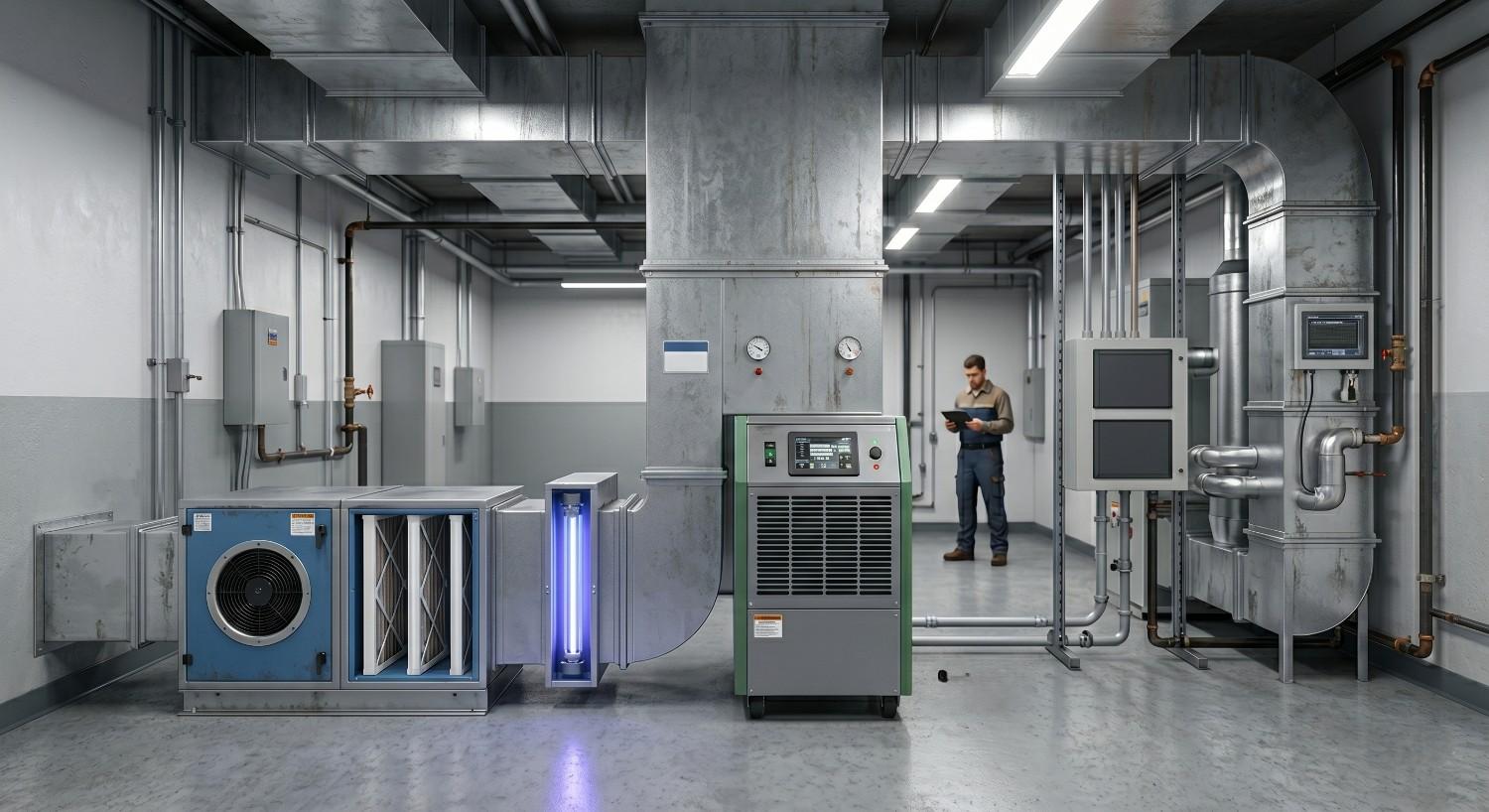
Commercial basements are one of the most overlooked — and most challenging — spaces when it comes to HVAC design. Whether you are managing a basement parking facility, a server room, a restaurant kitchen basement, a retail storage unit, or a utility room underneath a high-rise, the air quality challenge underground is significantly different from anything above ground.
Below-grade spaces face a unique combination of problems: no natural ventilation, moisture seeping through walls and floors, poor natural light (which compounds mold risk), and in many cases, heat-generating equipment or high occupancy loads. Getting the HVAC system right in a commercial basement is not about comfort alone — it is about safety, structural integrity, regulatory compliance, and protecting your investment. This guide covers everything facility managers, MEP consultants, and building owners need to know about ventilating, dehumidifying, and maintaining air quality in commercial basements across India.
Why Commercial Basements Demand Specialised HVAC Thinking
Most above-ground spaces can rely on a combination of natural ventilation and mechanical systems to maintain acceptable conditions. Basements have none of that flexibility. Every cubic metre of air has to be actively managed.
Here is what makes the problem unique:
No stack effect.
Natural ventilation relies on warm air rising and creating pressure differentials. Underground, this does not happen. You need mechanical systems for every air change.
Ground moisture infiltration.
Concrete is porous. In Indian cities with high water tables — Mumbai, Kolkata, Chennai, and many others — ground moisture wicks continuously into basement walls and slabs. Without active humidity control, this moisture enters the air and creates persistently high relative humidity levels.
Concentrated pollutants.
In parking basements, vehicle exhaust builds up rapidly. In basement kitchens, cooking fumes accumulate. In basement server rooms, heat density is extreme. These are not generic ventilation challenges — each requires a targeted approach.
Monsoon seasonality.
India's monsoon season from June to September dramatically intensifies every humidity challenge in a commercial basement. Even a well-managed facility during winter months can become dangerously humid during peak monsoon without the right systems in place.
Ventilation Requirements for Commercial Basements
How Many Air Changes Does a Commercial Basement Need?
The National Building Code of India and ASHRAE standards provide baseline air change per hour (ACH) requirements, but commercial basements often need to exceed these minimums based on occupancy and use type.
| Basement Use Type | Recommended ACH | Notes |
| Parking garage | 6–10 ACH | CO sensor-triggered control recommended |
| Restaurant kitchen (prep area) | 20–30 ACH | Exhaust must match supply to prevent negative pressure |
| Retail storage | 4–6 ACH | Humidity control equally important |
| Server/data room | 20–60 ACH | Depends on heat load; precision cooling required |
| Utility/generator room | 10–15 ACH | Heat and exhaust fume management critical |
| Office or occupied basement | 6–8 ACH | Fresh air supply must meet occupancy standards |
Supply Air vs. Exhaust Air Balance
One of the most common mistakes in basement ventilation design is failing to balance supply and exhaust airflow. A basement running in significant negative pressure (more exhaust than supply) will pull in unconditioned, humid outside air through every crack and gap — defeating your humidity control system entirely.
Equally, a basement running in positive pressure will push conditioned air out through openings, wasting energy.
For most commercial basements, a slight negative pressure in utility and parking areas (to contain contaminants) and neutral to slight positive pressure in occupied or sensitive areas is the recommended approach. AirTree's engineering team conducts detailed pressure mapping during system design to ensure every zone is balanced correctly.
Fresh Air Supply: The Right Equipment for Basements
The equipment used to supply conditioned fresh air into a basement must be selected for below-grade conditions. Standard rooftop units drawing fresh air from outside cannot simply be ducted down without accounting for static pressure losses in long duct runs and the need to condition air for basement-specific temperature and humidity targets.
AirTree's Double Skin Fresh Air Units are engineered for exactly this application. The double-skin panel construction provides superior thermal insulation — critical when conditioned air is being delivered through long duct runs in a warm, humid environment. The insulated panels prevent condensation forming on the outside of supply ducts, which is a common problem with single-skin units in basement environments.
For basements requiring precise fresh air delivery with humidity pre-treatment, AirTree's TFA (Treated Fresh Air) AHUs are the correct specification. These units cool, dehumidify, and filter 100% outdoor air before it enters the basement space, ensuring that the fresh air supply does not itself become a source of humidity loading.
Explore AirTree's Air Ventilation & Cooling System Range
Humidity Control in Commercial Basements
Understanding the Moisture Problem Below Grade
Humidity control in commercial basements is not a secondary concern — in many facilities, it is the primary HVAC challenge. Uncontrolled humidity in a basement leads to:
- Mold and mildew growth on walls, ceilings, and stored goods
- Corrosion of electrical panels, switchgear, and metal structures
- Damage to stored inventory in retail or restaurant basement areas
- Slip hazards from condensation on floors
- Deterioration of concrete reinforcement if moisture penetrates consistently over time
- HVAC equipment degradation, particularly coil and motor corrosion
In India's climate, achieving and maintaining a target relative humidity (RH) of 50–60% in a commercial basement requires active dehumidification — not just air conditioning.
Why Air Conditioning Alone Is Not Enough
This is one of the most frequent misconceptions among facility managers. Standard air conditioning systems are designed to cool air to a comfort setpoint, and they do remove some moisture in the process. But:
- AC systems cycle off when the space reaches the temperature setpoint, even if RH is still elevated.
- In basements where the heat load is low but moisture load is high (e.g., a storage basement), the AC system rarely runs long enough to adequately dehumidify.
- During monsoon, outdoor air entering the basement through infiltration or ventilation carries such a high moisture load that standard AC cannot keep up.
Dedicated dehumidification is essential for most commercial basements in India.
Choosing the Right Dehumidifier Type
AirTree offers two core dehumidification technologies, and the right choice depends on your basement's operating conditions:
Refrigerant Type Dehumidifiers
Best suited for basements operating above 15°C with moderate to high humidity. These units draw moist air over refrigerated coils, condense the moisture, and return dry air to the space. They are energy-efficient in standard temperature ranges and are the workhorse solution for most commercial basements including parking structures, retail storage, and occupied utility areas.
Key applications: Warehouse basements, retail storage, parking facilities, commercial kitchen prep areas.
Desiccant Type Dehumidifiers
For basements with lower ambient temperatures — cold storage areas beneath a facility, server rooms with precision humidity requirements, or pharmaceutical storage — desiccant dehumidifiers provide far more accurate and consistent humidity control. Unlike refrigerant-based units, their moisture removal capacity does not decrease at lower temperatures.
Key applications: Cold storage basements, pharmaceutical storage, precision equipment rooms, electronics manufacturing support areas.
View AirTree's Full Dehumidifier Range
Sizing Your Dehumidification System
Correct sizing is critical. An undersized system will run continuously without reaching target RH. An oversized system will short-cycle, reducing efficiency and increasing wear.
Moisture load calculations for a commercial basement should account for:
- Ground infiltration rate — dependent on wall construction, waterproofing quality, and local water table
- Ventilation moisture load — the moisture brought in with each air change from outside
- Occupancy load — each person adds approximately 40–60g of moisture per hour to the air
- Process loads — cooking, vehicle entry/exit, product storage off-gassing
- Seasonal variation — monsoon loads can be 3–4× the dry season baseline in many Indian cities
AirTree provides free moisture load calculations as part of every project engagement. Never size a dehumidifier from a catalogue chart without a site-specific calculation.
Air Quality Management in Commercial Basements
The Three Layers of Air Quality Risk Underground
Commercial basement air quality problems fall into three categories, and each requires a different approach:
Particulate matter and dust.
In parking basements, tyre dust and brake particulates accumulate rapidly. In storage areas, dust from goods movement is a constant challenge. Filtration in supply air units must be specified correctly, and exhaust systems must create sufficient air movement to prevent stratification.
Gaseous contaminants.
Carbon monoxide from vehicle exhaust in parking facilities is a life-safety concern — CO sensors connected to exhaust fan speed controllers are not optional, they are essential. In kitchen basements, grease vapour and combustion products require specialised exhaust handling.
Biological contaminants.
Mold spores thrive in the humid, low-light conditions typical of commercial basements. Once mold establishes in ductwork or on surfaces, it circulates through the entire ventilation system. Preventing the conditions that allow mold to grow — primarily by controlling humidity below 60% RH — is far more cost-effective than remediation.
Ventilation Equipment for Air Quality Control
For parking basement CO management: AirTree's SISW Exhaust Fans and Cabinet Fans provide the high-volume exhaust capacity required to dilute and remove vehicle exhaust from large basement parking areas. CO sensor integration allows fan speeds to modulate in response to actual contamination levels, reducing energy consumption during low-occupancy periods.
For kitchen basement fume extraction: AirTree's Double Skin Air Washers are engineered to handle the grease-laden, high-temperature exhaust from commercial kitchen basements. The double-skin construction contains heat and prevents external surface temperatures that could create maintenance hazards, while the air washing process removes grease particulates that would otherwise coat ductwork and create fire risks.
For general commercial basement air washing: AirTree's Hybrid Air Washer units combine sensible cooling, evaporative cooling, and DX cooling in a single system with automatic mode selection based on ambient humidity conditions. This makes them particularly well-suited to the variable seasonal conditions that Indian commercial basements face across a 12-month operating cycle.
The Role of Heat Recovery in Basement Energy Efficiency
Commercial basements often exhaust a significant volume of conditioned air to manage contaminant loads. In a high-ACH environment like a parking facility or kitchen basement, this represents a substantial energy cost. Heat Recovery Units (HRUs) capture the energy from exhaust air and transfer it to incoming fresh air, reducing the conditioning load on the primary cooling or heating system.
AirTree's Heat Recovery Units are specified for commercial and industrial facilities where continuous high-volume ventilation is required. For a basement running at 8–10 ACH continuously, heat recovery can reduce ventilation-related energy consumption by 50–70%.
Designing an Integrated Basement HVAC System
The AirTree Approach: Zone-by-Zone Design
The most effective commercial basement HVAC systems are designed zone-by-zone, with each area receiving equipment matched to its specific load profile. A uniform approach — installing the same system type throughout — almost always results in some zones being over-served and others under-served.
A typical large commercial basement might include:
- Main parking area: High-volume SISW exhaust fans with CO sensor control, fresh air supply through Double Skin Fresh Air Units
- Lift lobbies and stairwells: Pressurisation fans to prevent smoke ingress in emergency scenarios, conditioned air supply for occupant comfort
- Utility / generator rooms: Dedicated exhaust for heat and fumes, combustion air supply for generators
- Storage areas: Dehumidification-led system with moderate ventilation and filtration
- Any occupied spaces (security office, reception): Full HVAC treatment with treated fresh air, cooling coils, and filtration to occupancy standards
Equipment Selection Checklist for Basement HVAC
Before finalising equipment specifications for a commercial basement HVAC system, confirm the following:
☐ Moisture load calculation completed for each zone
☐ ACH requirements confirmed for each use type
☐ Supply/exhaust balance designed — no unintended pressure differentials
☐ CO sensor control specified for any parking or vehicle areas
☐ Seasonal variation (monsoon) factored into dehumidifier sizing
☐ Heat recovery evaluated for high-ACH exhaust zones
☐ Filtration levels matched to use type and occupancy
☐ Equipment corrosion resistance specified for basement environment
☐ Drainage confirmed for dehumidifiers and cooling coil condensate
☐ Access panels and maintenance clearances incorporated into design
Maintenance — Keeping Your Basement HVAC System Performing Year-Round
The Maintenance Calendar for Commercial Basement HVAC
Basement HVAC systems work harder than above-ground systems and face more aggressive environmental conditions. A structured maintenance programme is not optional — it is the difference between a 15-year equipment life and a 7-year one.
Monthly tasks:
- Inspect and clean or replace pre-filters in all air handling units
- Check CO sensor calibration in parking areas
- Inspect condensate drainage lines for blockages
- Visual check of all ductwork for condensation or moisture staining
Quarterly tasks:
- Clean cooling coils (grease-laden environments may require more frequent cleaning)
- Check and clean dehumidifier condenser coils
- Lubricate fan bearings where applicable
- Test all automated dampers and controls
Annual tasks:
- Full service of all fans — bearing inspection, impeller balancing, belt tension check
- Deep clean of all ductwork, particularly in kitchen exhaust systems
- Refrigerant level check on all DX equipment
- Full performance test — measure ACH and compare against design specification
- Inspect and replace gaskets on all access doors
Signs Your Basement HVAC System Needs Immediate Attention
Do not wait for the annual service if you observe any of the following:
- Visible condensation dripping from supply ducts or registers
- Musty or mouldy smell in any basement zone
- CO alarm activations in parking areas (indicates exhaust system underperformance)
- Humidity readings consistently above 65% RH despite dehumidifiers operating
- Noise or vibration from fans or air handling units that was not present previously
- Increased energy consumption without a corresponding increase in occupancy or use
Frequently Asked Questions: Commercial Basement HVAC
Q: What is the minimum ventilation requirement for a commercial basement parking facility in India?
The National Building Code of India specifies a minimum of 6 air changes per hour for basement parking facilities, with CO-controlled exhaust recommended so the system scales up during high-occupancy periods. Many consultants specify 8–10 ACH as the design point to provide margin.
Q: Do I need a separate dehumidifier if I already have an air conditioning system in my basement?
In most Indian commercial basements, yes. Air conditioning controls temperature, not humidity precisely. During monsoon season and in high-water-table locations, the moisture load entering a basement exceeds what a standard AC system can remove without compromising temperature control. A dedicated dehumidifier is the correct solution.
Q: What type of dehumidifier is best for a basement server room?
Server rooms require precise temperature and humidity control. Desiccant dehumidifiers are often preferred because their performance is consistent across the temperature range maintained in server rooms (typically 18–24°C), and they can achieve lower dew point setpoints than refrigerant units. AirTree can specify the correct combination of precision cooling and dehumidification for your server room load.
Q: How do I prevent condensation on cold water pipes running through my basement?
Pipe condensation is a humidity problem, not an insulation problem (though proper pipe insulation helps). The root cause is air in contact with the cold pipe surface being above the dew point temperature. Reducing basement RH to 50–55% through proper dehumidification will eliminate or greatly reduce pipe condensation.
Q: Can AirTree design an entire basement HVAC system, or do they only supply equipment?
AirTree provides end-to-end HVAC solutions — from initial site assessment and load calculations through equipment selection, supply, installation support, and after-sales service. Every project begins with a free consultation and technical assessment. Contact AirTree's engineering team to get started.
Conclusion: Getting Commercial Basement HVAC Right the First Time
A commercial basement that is poorly ventilated and humidity-controlled is a liability — for the building structure, for stored goods, for the equipment that operates there, and for anyone who works or spends time below grade. Getting it right requires more than selecting equipment from a catalogue. It requires a systematic approach: understanding the moisture load, designing for seasonal variation, balancing supply and exhaust, and specifying equipment that can perform in the demanding below-grade environment.
AirTree has been delivering HVAC solutions for commercial and industrial facilities across India since 2018. With in-house manufacturing, a team of experienced HVAC engineers, and a product range that covers every element of a basement HVAC system — from Tube Axial Fans and SISW Exhaust Fans to Double Skin Fresh Air Units, Dehumidifiers, Heat Recovery Units, and full Air Handling Units — AirTree is the partner you need for basement HVAC that works.
Ready to solve your commercial basement air quality challenge?
Call AirTree: +91 99589 91043 ???? Explore our products: airtreehvac.com/products ✉️ Email: sales@air-tree.com ???? Headquarters: Greater Noida, Uttar Pradesh
AirTree is a unit of We4U Maintenance Pvt Ltd, India's trusted HVAC and Air Handling Unit manufacturer. Established in 2018, AirTree serves 100+ cities across India with Pan India logistics and 24–48 hour response time on service queries.
Stay ahead with more industry insights
Join our newsletter to receive the latest HVAC technologies and ventilation solutions directly in your inbox.