Dehumidifier for Industrial Use: Applications, Benefits & Selection Tips
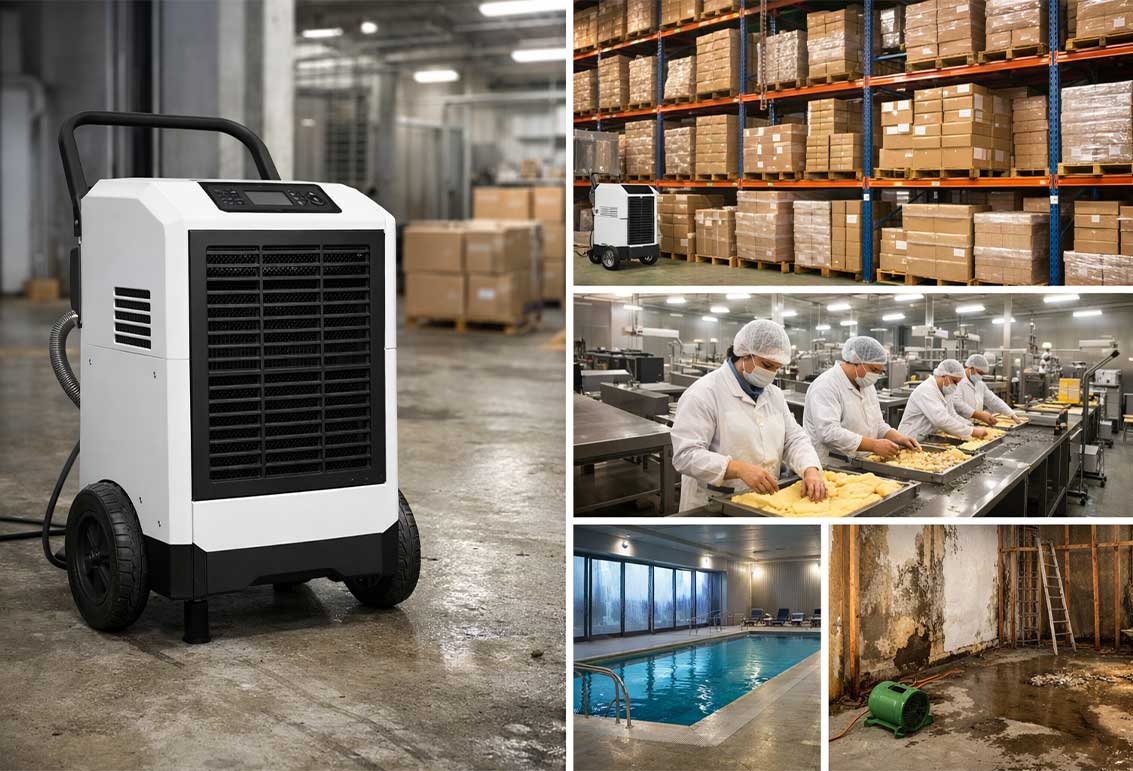
A dehumidifier for industrial uses is a heavy-duty system that removes moisture from large spaces like factories, warehouses, pharma plants, and cold stores, where excess humidity corrodes equipment, spoils products, and disrupts processes.
Moisture causes more industrial damage than most people realize. It accelerates metal corrosion, warps wooden structures, encourages bacterial and fungal growth, interferes with sensitive electronics, and compromises product quality across dozens of industries.
At Airtree, we've helped hundreds of industrial clients across India achieve precise humidity control. In this guide, we explain how industrial dehumidifiers work, the main types, where they're used, and how to select the right one for your facility.
Walk into any large-scale manufacturing plant, cold storage facility, or pharmaceutical production unit and you'll notice one thing: the air feels different. That's not a coincidence. Facility managers in these environments invest heavily in controlling humidity — and for good reason.
Moisture in the air causes more industrial damage than most people realize. It accelerates metal corrosion, warps wooden structures, encourages bacterial and fungal growth, interferes with sensitive electronics, and compromises product quality across dozens of industries. Industrial dehumidifiers are the frontline defense against all of these threats.
At Airtree, we've helped hundreds of industrial clients across India achieve precise humidity control tailored to their specific environments. In this guide, we break down where industrial dehumidifiers are used, why they matter, and how to choose the right one.
What is an Industrial Dehumidifier?
An Industrial dehumidifier is a heavy-duty moisture-removal system designed to operate continuously in large, demanding environments. Unlike residential units — which might handle a basement or a living room — industrial models are engineered for warehouses, factories, clean rooms, shipyards, tunnels, and more.
They come in two primary technologies:
- Refrigerant (mechanical) dehumidifiers — draw air over cold coils to condense and drain moisture. Best for temperatures above 15°C.
- Desiccant dehumidifiers — use a moisture-absorbing rotor (silica gel or zeolite) to extract humidity. Highly effective at low temperatures and very low humidity levels.
Many industrial facilities require hybrid systems combining both technologies to achieve optimal results across varying conditions.
Key Industrial Applications
Industrial dehumidifiers serve a remarkably wide range of sectors. Here are the most critical applications:
- Manufacturing Plants
Controls corrosion on metal parts and assemblies; prevents condensation on machinery and tools.
- Pharmaceuticals
Strict RH control during production and storage of medicines, capsules, and biologics.
- Food & Beverage
Prevents microbial growth, clumping, and spoilage in processing and packaging areas.
- Electronics & Semiconductors
Protects sensitive components from static discharge and moisture-induced short circuits.
- Cold Storage & Logistics
Eliminates frost formation on evaporators, floors, and goods in refrigerated warehouses.
- Oil, Gas & Marine
Protects pipelines, rigs, and vessels from corrosion during storage, construction, and operation.
- Printing & Paper
Prevents paper absorption of moisture that causes misfeeds, wrinkles, and poor print quality.
- Construction & Tunnels
Accelerates drying of concrete, plaster, and coatings; prevents condensation in enclosed spaces.
Beyond these sectors, industries like textile manufacturing, museums and archives, military storage, and power generation also rely on controlled humidity to protect assets and maintain operational integrity.
Benefits of Using Industrial Dehumidifiers
The return on investment for industrial dehumidification is well-documented. Here's what controlled humidity actually delivers:
01 Corrosion Prevention
Metals corrode rapidly above 50% RH. Dehumidifiers stop rust formation on equipment, tools, and structures.
02 Product Quality
Moisture-sensitive goods — from food to electronics — maintain quality, shelf life, and regulatory compliance.
03 Mold & Microbial Control
Keeping RH below 60% effectively prevents mold, bacteria, and other biological contamination.
04 Worker Safety & Comfort
Reduces slippery floors from condensation, improves air quality, and reduces heat stress in high-humidity workplaces.
05 Energy Efficiency
HVAC systems work harder in humid air. Lower RH means less load on cooling systems and lower energy bills.
06 Process Accuracy
Many industrial processes (coating, painting, adhesive bonding) require precise humidity ranges for consistent outcomes.
Airtree insight: In our experience working with Indian manufacturing facilities, uncontrolled humidity is responsible for up to 40% of unexpected equipment maintenance costs — especially in coastal and high-monsoon regions like Mumbai, Chennai, and Kolkata. A well-sized dehumidification system typically pays for itself within 12–18 months through reduced corrosion damage alone.
How to Select the Right Industrial Dehumidifier
Choosing the wrong unit is almost as bad as having none at all. An undersized system struggles to maintain target RH; an oversized one wastes energy and capital. Here are the key factors to evaluate:
1. Determine your target humidity level
Different applications demand different RH ranges. Pharmaceutical clean rooms may require as low as 30% RH, while a general manufacturing warehouse might need 50–55%. Define your target before sizing any equipment.
2. Calculate the moisture load
The total moisture that must be removed depends on: the volume of the space, the number of air changes needed, the ambient conditions (outdoor air temperature and humidity), internal moisture sources (people, machinery, wet processes), and the frequency of door openings.
3. Choose the right technology
| Factor | Refrigerant Dehumidifier | Desiccant Dehumidifier |
|---|---|---|
| Best temperature range | 15°C – 45°C | -20°C – 35°C |
| Best for humidity levels | Above 40% RH | Below 40% RH |
| Energy consumption | Lower at moderate conditions | Higher, but more effective in cold |
| Typical use case | Warehouses, food plants | Pharma, cold storage, electronics |
4. Consider airflow and ducting requirements
Industrial dehumidifiers must integrate with your existing HVAC and ventilation systems. Look for units with flexible ducting options, remote sensor compatibility, and BMS (Building Management System) integration for automated control.
5. Factor in maintenance and serviceability
Industrial equipment runs continuously. Prioritize units with accessible filter compartments, easy refrigerant inspection points, and local service support. Airtree provides on-site installation, commissioning, and annual maintenance contracts across major Indian cities, ensuring your systems remain operational year-round.
6. Certifications and compliance
For pharmaceutical and food industries, ensure your dehumidifier meets relevant standards such as GMP guidelines, FDA 21 CFR, and local BIS certifications. Ask your supplier for documentation to support regulatory audits.
Why Choose Airtree for Industrial Dehumidification?
Airtree is one of India's trusted specialists in industrial air treatment solutions. Our range of industrial dehumidifiers is engineered for performance in India's challenging climate — from the coastal humidity of Mumbai to the extreme monsoon conditions of the northeast.
- Wide capacity range from 20 litres/day to 5,000+ litres/day
- Refrigerant and desiccant models for every application
- Custom-engineered systems for non-standard environments
- Pan-India installation and service network
- Energy-efficient designs with smart humidity controllers
- Free site surveys and humidity load calculations
Whether you're running a pharmaceutical production unit in Hyderabad, a cold chain warehouse in Pune, or a printing facility in Delhi, Airtree has a dehumidification solution designed for your specific operational requirements.
Frequently Asked Questions
Q1. What is the ideal humidity level for industrial environments?
It varies by industry, but most industrial applications target a relative humidity (RH) between 40% and 55%. Pharmaceutical facilities often require 30–45% RH, food processing areas typically target 50–60% RH, and electronics manufacturing may need as low as 30–35% RH. Your Airtree specialist can help define the right target for your process.
Q2. How is an industrial dehumidifier different from a commercial one?
Industrial dehumidifiers are designed for continuous, heavy-duty operation in large spaces — typically 1,000 sq ft and above. They have higher moisture removal capacities (measured in litres per day or kg/hr), more durable construction, advanced controls, and the ability to integrate with central HVAC systems. Commercial units are suited for offices, hotels, and retail spaces with lighter demands.
Q3. Which is better for industrial use — refrigerant or desiccant dehumidifiers?
It depends on your operating conditions. Refrigerant dehumidifiers are energy-efficient for spaces above 15°C with moderate humidity levels. Desiccant dehumidifiers outperform in low temperatures, very low RH targets, or in applications requiring ultra-dry conditions. Many large-scale facilities use a combination of both for optimal results.
Q4. How do I calculate the size of dehumidifier I need?
Sizing involves calculating the total moisture load, which accounts for the room volume, air change rates, ambient outdoor conditions, internal moisture sources, and the target RH level. Airtree offers free site assessments and humidity load calculations to help you select the correctly sized unit without guesswork.
Q5. Can industrial dehumidifiers be integrated with existing HVAC systems?
Yes. Most modern industrial dehumidifiers support ducted installation and can be integrated with building management systems (BMS) for centralized monitoring and automated control. Airtree's engineering team handles full integration with existing infrastructure during the installation process.
Q6. How often do industrial dehumidifiers need maintenance?
Most industrial dehumidifiers require filter cleaning every 1–3 months depending on the dust load of the environment, and a comprehensive service check every 6–12 months. Airtree offers Annual Maintenance Contracts (AMC) to keep your systems running at peak performance with scheduled visits and priority support.
Q6. Is humidity control important even in air-conditioned industrial spaces?
Absolutely. Standard air conditioning cools the air but does not always achieve precise RH control, especially when outdoor humidity is high (as in India during monsoons). A dedicated dehumidifier ensures your RH targets are consistently maintained regardless of the AC performance or fluctuating outdoor conditions.
Ready to protect your facility?
Humidity-related damage is preventable — and the cost of inaction is always greater than the cost of a proper dehumidification system. Airtree brings decades of air treatment expertise to help you design, install, and maintain the right solution for your industrial environment. Contact our team today for a free site survey and humidity assessment tailored to your facility's needs.
Stay ahead with more industry insights
Join our newsletter to receive the latest HVAC technologies and ventilation solutions directly in your inbox.