Different Types of Air Handling Units and Their Applications
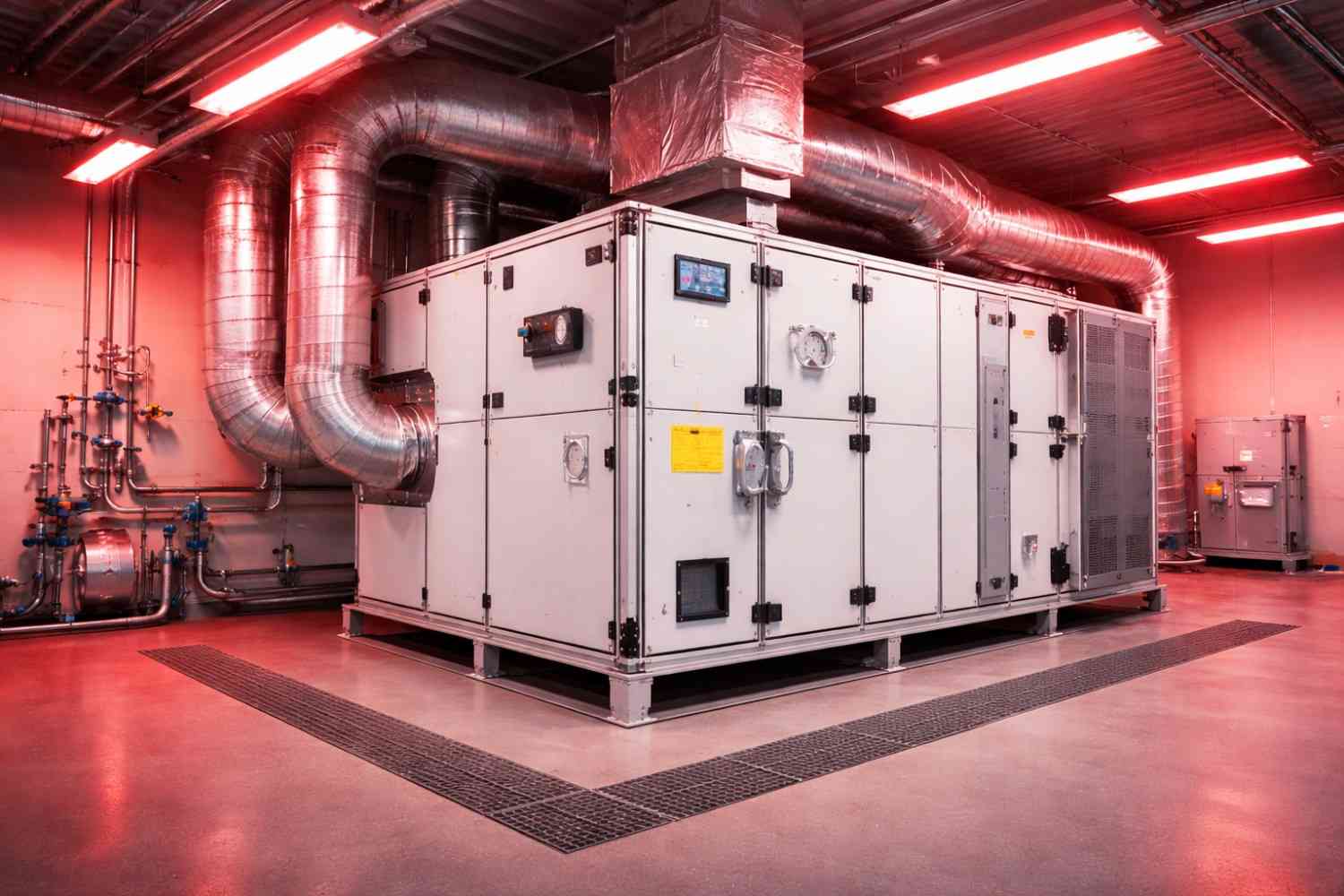
When you walk into a hospital, a pharmaceutical plant, a shopping mall, or even a well-maintained office building, one thing is almost always working silently behind the scenes — an Air Handling Unit. Most people never notice it. But the moment it stops working, everyone does. At Airtree, we have spent years engineering and supplying air handling solutions across some of India's most demanding environments. Over time, one question keeps coming up from facility managers, MEP consultants, and project engineers alike: "Which type of AHU is right for my application?"
What Exactly Is an Air Handling Unit?
An Air Handling Unit, commonly called an AHU, is a piece of equipment that conditions and circulates air as part of a Heating, Ventilation, and Air Conditioning (HVAC) system. Think of it as the lungs of a building — it draws in air, treats it (cools, heats, filters, dehumidifies), and then delivers it to occupied spaces through a duct network.
A typical AHU consists of:
- Fans/blowers to move air through the system
- Cooling or heating coils to adjust air temperature
- Filters to remove dust, particulates, and allergens
- Dampers to control airflow volumes
- Drain pans to collect condensate
- An insulated casing to prevent energy losses
The key differentiator between AHU types is not just the shape or size — it is the application they are designed for, the airflow capacity they handle, and where they are physically installed within a building.
The Main Types of Air Handling Units
1. Vertical AHU
The Vertical AHU is one of the most widely used configurations in commercial and institutional buildings across India. As the name suggests, all the internal components — the fan section, coil section, and filter section — are stacked vertically within the unit's casing. This allows the AHU to have a smaller floor footprint compared to its horizontal counterpart, making it a practical choice where floor space is limited but ceiling height is available.
How it works: Air enters from the bottom or side of the unit, passes through the filtration and coil sections in a vertical path, and exits through the top or the side into the ductwork.
Key strengths:
- Compact footprint, ideal for plant rooms with space constraints
- Efficient vertical airflow reduces resistance
- Easier access for maintenance of coils and filters from the front
- Handles both return air and fresh air mixing effectively
Where Airtree's Vertical AHUs are used:
- IT parks and data centres where consistent temperature and humidity are non-negotiable
- Hospitals and healthcare facilities where air quality directly impacts patient outcomes
- Pharmaceutical plants where precise environmental control is a regulatory requirement
- Hotels, malls, and auditoriums where large spaces need to be uniformly conditioned
If you are specifying an AHU for a space-constrained plant room while needing reliable performance at scale, the vertical AHU is often the most practical answer..
2. Floor Mounted AHU (Horizontal Configuration)
Floor Mounted AHUs — sometimes referred to as the "above long one" configuration in large-capacity variants — are heavy-duty, horizontally arranged units built for high air volume and critical applications. Unlike vertical units, the components here are arranged in a horizontal sequence, which makes the unit longer but also allows for more internal surface area, better heat transfer, and higher airflow capacities.
These units sit directly on the floor of a plant room or mechanical space. They are typically custom-built to project specifications, making them ideal for projects where airflow volumes and environmental conditions are demanding and non-standard.
Key strengths:
- Handles significantly higher CFM (cubic feet per minute) compared to standard vertical units
- Better suited for critical clean environments with multiple filter stages
- Easier to install multiple coil banks (pre-cooling, heating, re-heating) in sequence
- More accessible for servicing in high-maintenance environments
Common applications:
- Manufacturing and industrial facilities where large volumes of process air need to be conditioned
- Pharmaceutical production zones and clean rooms with stringent air change rate requirements
- Hospitals — particularly operation theatres and ICUs — where air quality and pressure control are critical
- Laboratories and research facilities requiring validated environmental conditions
- Airports and large transit hubs handling high occupant loads and continuous operation
At Airtree, our floor mounted AHUs are engineered for demanding performance and are available in both Return Air (RA) and Fresh Air (FA) or Treated Fresh Air (TFA) configurations depending on what the application demands.
3. Ceiling Suspended AHU
Not every project has an available mechanical room or spare floor space. In commercial buildings, retail spaces, and multi-floor office complexes, it is often more practical to mount the AHU up in the false ceiling space and let it work above the occupied area. That is precisely the role of the Ceiling Suspended AHU.
These are compact, lightweight units that are mounted on hangers or structural support brackets above the false ceiling. They deliver conditioned air directly into the space below through short ducting or diffusers, making them ideal for distributed air conditioning across multiple zones.
Key strengths:
- Frees up valuable floor and wall space entirely
- Ideal for retrofits or renovations where creating a mechanical room is not feasible
- Shorter duct runs mean less pressure drop and better energy efficiency
- Available with or without Treated Fresh Air (TFA) integration
Airflow range: Airtree's ceiling suspended AHUs are available from 700 CFM to 12,000 CFM, covering everything from small meeting rooms to large open-plan floors.
Common applications:
- Corporate offices and commercial buildings across multiple floors
- Hotels — particularly guest corridors, lobbies, and banquet spaces
- Shopping malls where AHUs need to be distributed throughout the building
- Hospitals in general ward areas where centralised plant rooms may be overloaded
If your project has limited mechanical space but requires flexible, zone-by-zone cooling, ceiling suspended AHUs from Airtree offer an efficient and practical solution. Browse the full range on our Air Handling Unit product page.
4. Treated Fresh Air Unit (FAU / TFAU)
A regular AHU typically recirculates a mix of return air and a controlled percentage of fresh outdoor air. But in certain environments — particularly those where indoor air quality is paramount — you need a dedicated unit that conditions 100% fresh outside air before it enters the occupied space. That is what a Fresh Air Unit or Treated Fresh Air Unit (TFAU) is designed to do.
The TFAU takes raw outdoor air — which can be hot, humid, and laden with pollutants in Indian climatic conditions — and treats it through cooling, dehumidification, and filtration before it is delivered into the building. This pre-conditioned fresh air is then blended with the air already circulating in the space through the main AHU.
Why it matters:
India's climate, especially in northern and western regions, sees outdoor conditions that can reach 45°C with very high humidity during summer. Bringing untreated air directly into a building would overwhelm the main air conditioning system. A dedicated TFAU takes the load off the primary system while ensuring the incoming air is already at a comfortable and safe condition.
Key benefits of Airtree's TFAU:
- Dramatically improves indoor air quality by ensuring a constant supply of fresh, filtered air
- Controls humidity independently, reducing mould and air quality complaints
- Energy efficient — prevents the main AHU from working harder to handle high-latent-load fresh air
- Compliant with ASHRAE ventilation standards and NBC (National Building Code) requirements
Applications:
- IT parks with high human density and stringent ventilation standards
- Hospitals and pharma units where fresh air changes per hour are mandated
- Hotels and auditoriums with variable and high occupancy
- Green buildings targeting LEED or GRIHA ratings that require verified fresh air delivery
How to Choose the Right AHU for Your Project
Choosing between these four types is not always straightforward. Here is a simplified decision framework that Airtree's engineering team uses when assessing project requirements:
| Parameter | Recommended AHU Type |
| Limited floor space, standard commercial use | Vertical AHU |
| High airflow volume, critical/industrial use | Floor Mounted AHU |
| No mechanical room, distributed zoning | Ceiling Suspended AHU |
| 100% fresh air requirement, high IAQ focus | TFAU / FAU |
| Combined fresh air + recirculation | Vertical or Floor Mounted with TFAU integration |
In practice, most large projects use a combination — for example, a floor mounted main AHU handling return air conditioning alongside a dedicated TFAU bringing in pre-treated fresh air. Airtree's engineering team can help you figure out the right combination for your specific project.
Why Airtree for Your AHU Requirements
At Airtree, we are not just equipment suppliers — we are HVAC solution partners. Every unit we manufacture goes through rigorous quality checks to ensure it meets the performance parameters promised at the time of design. Our AHUs are used across hospitals, pharma plants, IT campuses, hotels, and industrial facilities throughout India.
What sets us apart:
- Custom engineering — we design AHUs to your exact airflow, static pressure, and spatial requirements
- Wide range — from 700 CFM ceiling suspended units to large-capacity floor mounted units for critical environments
- Application expertise — our team understands the unique demands of pharma, healthcare, IT, and hospitality sectors
- After-sales support — through our dedicated service network, we ensure your systems keep running at peak efficiency
Explore our complete Air Handling Unit catalogue here or get in touch with our team for a consultation.
Frequently Asked Questions (FAQs)
Q1. What is the difference between an AHU and an FCU (Fan Coil Unit)?
An AHU is a large, centralised unit that conditions and distributes air to an entire building or a large zone through a duct network. An FCU (Fan Coil Unit) is a smaller, decentralised unit typically installed in individual rooms or zones. AHUs handle larger airflow volumes and are more suitable for complex HVAC systems, while FCUs are simpler and better suited for room-level control
Q2. What does "Treated Fresh Air" (TFA) mean in an AHU?
Treated Fresh Air refers to outdoor air that has been cooled, dehumidified, and filtered before being supplied into an occupied space. A TFAU (Treated Fresh Air Unit) handles 100% outdoor air — unlike a standard AHU which may recirculate a mix of fresh and return air. TFAUs are especially important in Indian climates where outdoor conditions are harsh.
Q3. What is a good CFM range for a ceiling suspended AHU?
For most commercial applications, ceiling suspended AHUs range from 700 CFM to 12,000 CFM. Airtree's ceiling suspended range covers this entire spectrum. The right CFM depends on the area being conditioned, occupancy levels, and heat load calculations.
Q4. Which type of AHU is used in pharmaceutical clean rooms?
Pharmaceutical clean rooms typically use floor mounted AHUs with multi-stage filtration (including HEPA filters) and tight control over temperature, humidity, and air change rates. These are often custom-engineered to meet GMP (Good Manufacturing Practice) guidelines. Airtree has significant experience supplying AHUs for pharma environments.
Q5. How often should an AHU be serviced?
Filters should be inspected monthly and cleaned or replaced every 3–6 months depending on the environment. Cooling coils, drain pans, and blowers should be serviced at least twice a year. In critical environments like hospitals and pharma plants, quarterly servicing is recommended. Airtree offers dedicated after-sales and maintenance support for all its AHU installations.
Q6. Can an AHU work without a cooling coil — just for ventilation?
Yes. In some applications, particularly in industrial or warehousing environments, AHUs are used primarily for fresh air ventilation without active cooling. In this case, the unit may only include a fan section and filters. However, for human comfort applications, a cooling coil is almost always necessary in Indian climate conditions.
Q7. What is the typical lifespan of an AHU?
A well-manufactured and regularly maintained AHU can last 15–20 years. The lifespan depends on the quality of construction (casing material, coil material, fan type), operating conditions (humidity, dust levels, run hours), and the regularity of preventive maintenance.
Q8. What certifications should I look for when buying an AHU in India?
Look for manufacturers that follow ASHRAE 62.1 (ventilation standards), ARI 430 (central-station air handling units), and ISO 9001 quality management standards. For pharmaceutical applications, GMP compliance is also critical. Always ask for performance data sheets and third-party testing reports.
Stay ahead with more industry insights
Join our newsletter to receive the latest HVAC technologies and ventilation solutions directly in your inbox.