What Is Industrial Dehumidification and How Dehumidifiers Work
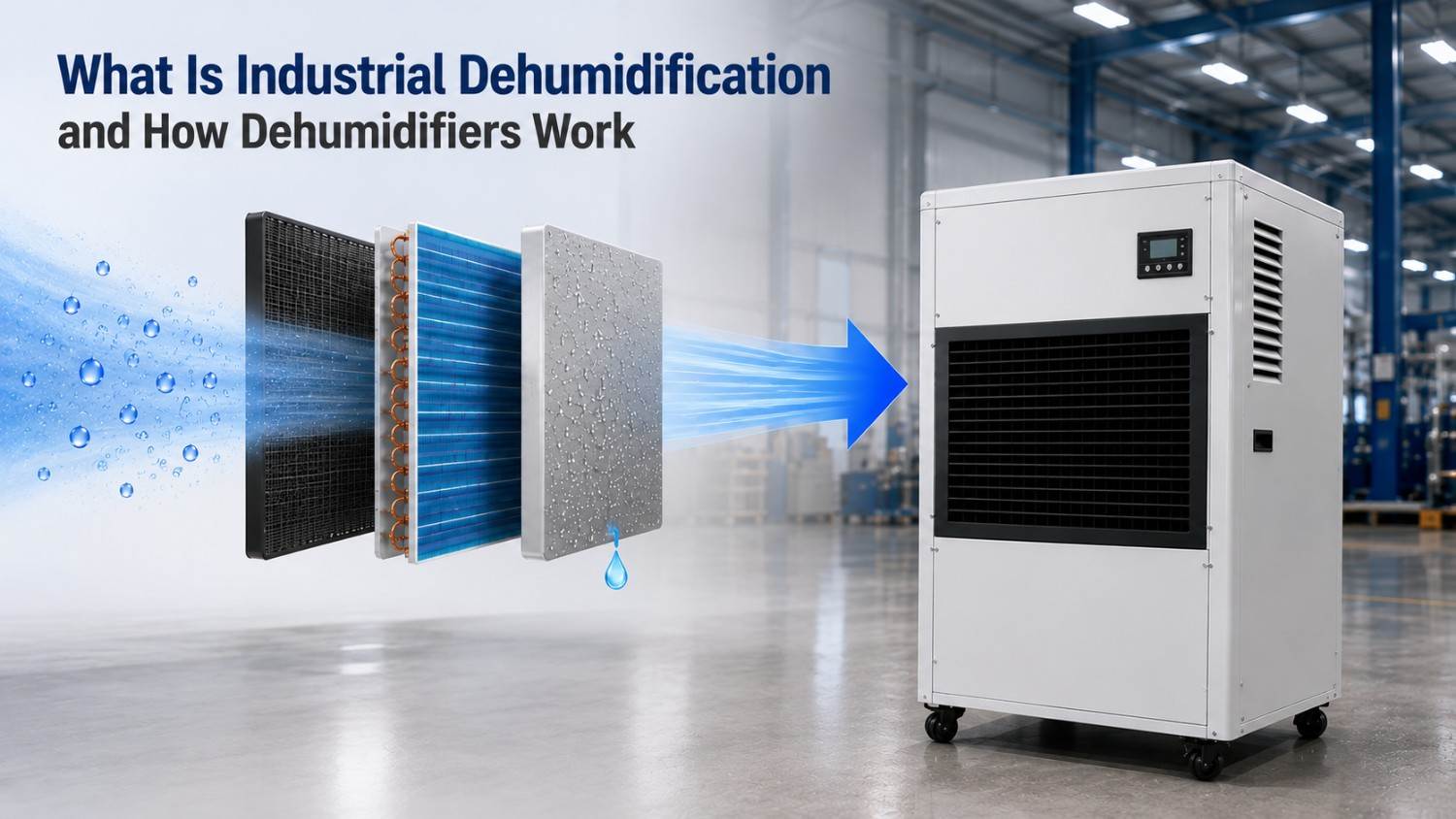
Walk into any large warehouse, food processing plant, or pharmaceutical facility, and you'll notice something you might not expect: the air feels different. Dry, almost crisp, even on a humid summer day. That's not an accident. It's the result of industrial dehumidification, a process that quietly protects products, equipment, and entire buildings from one of the most underestimated threats in manufacturing — moisture.
Most people think of dehumidifiers as small appliances that sit in a damp basement, humming away to keep mildew off the walls. But scale that concept up to an entire production floor, a cold storage warehouse, or a data center, and you're dealing with a completely different animal. Industrial dehumidification is a specialized science, and understanding how it works can save businesses a lot of money, headaches, and product loss.
Why Humidity Control Matters So Much in Industry
Every facility has an ideal humidity range, and straying from it causes real problems. Too much moisture in the air, and you start seeing condensation on machinery, corrosion on metal parts, mold growth on packaging, and even electrical failures. In industries like pharmaceuticals or electronics manufacturing, excess humidity can ruin entire batches of product or damage sensitive components beyond repair.
Food processing plants face their own set of headaches. Moisture in the air encourages bacterial growth, shortens shelf life, and can cause ice buildup in cold storage areas. Warehouses storing paper, textiles, or wood products deal with warping, staining, and weight changes that throw off inventory accuracy. Even something as simple as a slippery, condensation-covered floor becomes a safety hazard when humidity isn't managed.
This is why industrial dehumidification isn't a luxury add-on. For many businesses, it's a core part of quality control and risk management. At Airtree, we manufacture both refrigerant and desiccant type industrial dehumidifiers, and we've seen firsthand how the right setup can be the difference between a facility that runs smoothly and one that's constantly fighting avoidable problems.
The Basic Science Behind Dehumidification
To understand how industrial dehumidifiers work, it helps to remember a basic fact about air: warm air holds more moisture than cold air. When air cools down, it can't hold onto as much water vapor, so that excess moisture has to go somewhere. That's the principle nearly every dehumidifier relies on, whether it's sitting in your bedroom or running around the clock in a manufacturing plant.
Industrial systems typically use one of two main approaches to pull moisture out of the air: refrigeration-based dehumidification or desiccant-based dehumidification. Each has its strengths, and choosing between them usually comes down to the temperature and humidity conditions of the space being treated.
Refrigerant Dehumidifiers
Refrigerant dehumidifiers work a lot like an air conditioner, and in fact, they share much of the same core technology. A fan pulls humid air into the unit and passes it over a set of cold refrigerant coils. As the air touches these cold surfaces, its temperature drops quickly, and since cold air can't hold as much moisture, the water vapor condenses into liquid droplets right there on the coils. That water then drains away or collects in a reservoir, while the now-drier air passes over a second set of coils to be reheated slightly before it's released back into the room.
This method works best in warmer environments, generally when temperatures are above 60 degrees Fahrenheit. It's efficient, relatively low-maintenance, and well suited to spaces like general warehouses, gyms, breweries, and indoor pools where humidity and temperature stay in a moderate range. Airtree's refrigerant type units, for instance, are built specifically for warehouses, storage rooms, pharmaceutical and food industries, and even water leakage or flood recovery situations where you need reliable moisture removal without a huge energy footprint.
Desiccant Dehumidifiers
Desiccant systems take a completely different route. Instead of cooling the air, they use a moisture-absorbing material, often silica gel, activated alumina, or a lithium chloride compound, to physically capture water vapor. Air passes through or over a rotating wheel coated in this desiccant material. The material soaks up moisture the way a sponge absorbs water, and the now-dry air continues on into the facility.
Of course, that desiccant wheel can't just keep absorbing moisture forever. A separate section of the wheel is continuously heated to release, or "regenerate," the trapped water vapor, which then gets vented outside. This cycle runs continuously, allowing the system to keep working nonstop.
Desiccant dehumidifiers shine in cold or low-humidity environments where refrigerant systems struggle, think cold storage facilities, ice rinks, or pharmaceutical cleanrooms that need extremely low humidity levels, sometimes below 20% relative humidity. They can also handle much larger volumes of air and are often the go-to choice in industries where precision matters more than energy savings. Airtree's desiccant type dehumidifiers are engineered for exactly these conditions, cold storage and refrigerated rooms, paint booths, electronics manufacturing, and hospital or cleanroom environments that demand a very low, tightly controlled dew point.
Choosing the Right System for the Job
Picking between refrigerant and desiccant technology isn't just a matter of preference. Facility engineers usually consider factors like the target humidity level, ambient temperature, the size of the space, and how much airflow needs to be treated. A brewery trying to control condensation in a moderately warm bottling room has very different needs than a semiconductor plant that requires bone-dry air to prevent static damage to microchips.
Many large operations actually use a hybrid approach, combining both technologies or pairing dehumidifiers with HVAC systems to fine-tune conditions throughout the day. This is also where Heat Recovery Units come in, they capture waste heat from exhaust air and transfer it back into incoming fresh air, which cuts down the load on your cooling and heating systems and lowers overall energy bills. Airtree manufactures these alongside our dehumidifier range for exactly this kind of integrated setup. Sensors placed around the facility constantly monitor humidity and temperature, feeding data back to control systems that adjust the dehumidification equipment automatically. This kind of automation has become increasingly common, letting facilities maintain tight tolerances without needing someone to manually check gauges every hour.
At Airtree, this is exactly the kind of assessment we walk clients through, looking at their space, their product, and their goals before recommending a single piece of equipment. There's no one-size-fits-all answer, and the right recommendation always starts with understanding the specific facility.
The Bigger Picture: Energy and Cost Considerations
It's worth noting that industrial dehumidification isn't free, and running large systems around the clock does add to a facility's energy bill. That said, the cost of not controlling humidity is almost always higher. Product spoilage, equipment corrosion, mold remediation, and structural damage from moisture add up fast, often dwarfing the operating cost of the dehumidification equipment itself.
Newer systems are also getting smarter about efficiency. Energy recovery components, variable speed fans, and improved desiccant materials have all helped reduce the power draw of modern units compared to older generations. Facilities that once ran dehumidifiers at full blast constantly are now able to modulate output based on real-time conditions, cutting energy waste without sacrificing performance.
Final Thoughts
Industrial dehumidification might not be the most glamorous topic, but it plays a genuinely critical role behind the scenes of countless industries. Whether it's keeping a pharmaceutical cleanroom within strict humidity tolerances or preventing rust on machinery in a manufacturing plant, the technology quietly does its job so that products stay safe, equipment lasts longer, and facilities run smoothly. Understanding the basic mechanics, refrigeration versus desiccant, helps explain why this unassuming equipment is such a valuable investment for so many businesses.
If you're evaluating humidity control options for your own facility, the team at Airtree is always happy to talk through what would actually work best for your space rather than pushing a one-size-fits-all solution.
Frequently Asked Questions (FAQ)
1. What is industrial dehumidification?
Industrial dehumidification is the process of removing excess moisture from air to maintain controlled humidity levels in industrial spaces.
2. How does an industrial dehumidifier work?
It draws in humid air, removes moisture through cooling or desiccant technology, and releases drier air back into the space.
3. Why is dehumidification important in industries?
It helps prevent corrosion, mold, condensation, product damage, and moisture-related equipment problems.
4. Where are industrial dehumidifiers commonly used?
They are used in warehouses, manufacturing plants, pharmaceutical facilities, food processing units, cold storage, and storage areas.
5. What are the main types of industrial dehumidifiers?
The two common types are refrigerant dehumidifiers and desiccant dehumidifiers.
6. Why choose Airtree for industrial dehumidification solutions?
Airtree provides reliable HVAC and industrial dehumidification solutions designed for effective moisture control, energy efficiency, and industrial applications.
Stay ahead with more industry insights
Join our newsletter to receive the latest HVAC technologies and ventilation solutions directly in your inbox.