Industrial Dehumidifier for Cold Storage and Food Processing Units
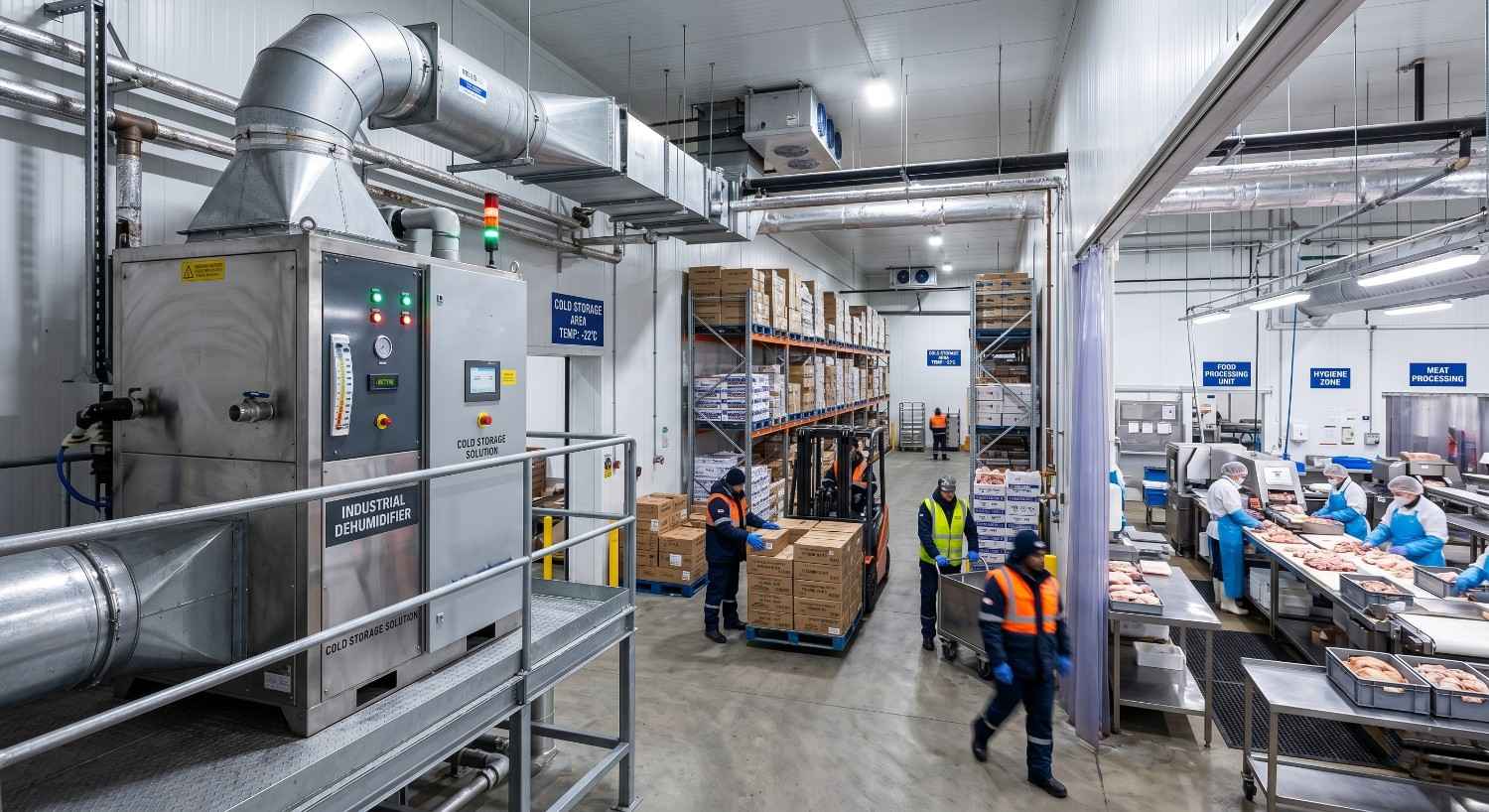
Walk into any cold storage facility or food processing unit during peak summer or monsoon season in India, and the battle against moisture becomes immediately visible — condensation dripping off walls, packaging going soft, produce ripening faster than expected, and a faint musty smell that never quite leaves. This is not just a comfort issue. In the food industry, uncontrolled humidity means spoilage, contamination, regulatory non-compliance, and direct revenue loss.
This is exactly where Airtree's Industrial dehumidifiers make a measurable difference. Designed specifically for high-demand environments, Airtree's dehumidification systems help cold storage operators and food processing facilities maintain precise relative humidity (RH) levels — protecting inventory, equipment, and the safety of every product that moves through the facility.
Why Humidity is the Biggest Hidden Threat in Cold Storage and Food Processing
Most facility managers focus on temperature control. Compressors are serviced, temperature logs are maintained, and chillers are monitored around the clock. But relative humidity rarely gets the same attention — and that is a costly oversight.
Here is what happens when RH levels go unmanaged in a food environment:
• Mold and bacterial growth accelerate dramatically above 70% RH, turning safe storage conditions into a contamination risk within days.
• Frost formation on evaporator coils reduces cooling efficiency, increases energy consumption, and forces more frequent defrost cycles.
• Packaging materials — cardboard, paper, and even some plastics — absorb moisture, weakening structural integrity and making them look unsellable.
• Dry goods such as spices, grains, flour, and sugar clump or cake together, making them difficult to process and reducing product quality.
• Condensation on floors creates slip hazards, adding an occupational safety risk on top of the product loss.
• Wooden pallets and structural elements absorb moisture over time, leading to warping and premature replacement costs.
India's climate compounds these problems significantly. Coastal regions like Mumbai and Chennai face year-round humidity challenges. Northern and central regions experience intense monsoon periods from June to September when outdoor RH can exceed 90%. Without active humidity control, even a well-insulated facility will struggle to maintain stable internal conditions.
How Airtree's Industrial Dehumidifiers Work in Cold and Food Environments
Airtree engineers industrial dehumidification systems with an understanding that cold storage and food processing are not standard environments. Temperature ranges can drop as low as -20°C in blast freezing zones, while ambient areas in the same facility may run at 10°C to 15°C. Standard refrigerant-based dehumidifiers struggle in low-temperature conditions — this is where Airtree's expertise in selecting the right technology for the right zone becomes critical.
Refrigerant-based dehumidifiers
Ideal for ambient storage zones and processing halls operating above 15°C. These units draw humid air over cold coils, condense the moisture, and return dry, temperature-stable air to the space. They are energy-efficient in moderate temperature ranges and well-suited to large open floor areas in processing units.
Desiccant dehumidifiers
In blast freezing areas, cold rooms operating below 5°C, and freezer ante-rooms, desiccant technology performs far more reliably. A rotating silica gel or zeolite rotor absorbs moisture from the air without relying on condensation. Airtree recommends desiccant systems for any zone where the ambient temperature consistently falls below 15°C.
Hybrid and integrated systems
Large facilities often need both technologies working in parallel across different zones. Airtree's engineering team conducts a full humidity load assessment before recommending a configuration, ensuring each zone gets the right unit — not just the most convenient one.
Key Applications: Where Airtree Dehumidifiers Are Used in the Food Sector
Humidity control needs vary significantly depending on the type of facility and what is being stored or processed. Airtree works across the following environments:
Cold storage warehouses
Fresh produce, dairy, meat, and seafood storage requires RH levels between 85% and 95% for many products — but that precision only works when humidity is actively managed, not left to chance. Uncontrolled spikes above target RH cause premature spoilage. Airtree's systems maintain tight RH bands, reducing post-harvest losses for operators dealing with high-value inventory.
Dry food storage and grain silos
Flour mills, spice processors, rice storage units, and grain silos face the opposite challenge — they need to keep RH below 60% to prevent caking, insect infestation, and microbial growth. Even a brief period of elevated humidity during loading or unloading can compromise an entire batch.
Food and beverage processing lines
Packaging halls, filling lines, and open processing areas where food is exposed to the environment are particularly vulnerable. Any condensation falling onto a product or work surface is a potential contamination event. Airtree's dehumidifiers prevent this by maintaining dry, stable air conditions throughout production hours.
Ante-rooms and loading dock areas
The transition zone between a cold room and the ambient environment is where humidity infiltration is most severe. Every time a cold room door opens, warm moist air rushes in. Airtree designs dedicated ante-room dehumidification solutions that create a dry air buffer, significantly reducing the humidity load on the cold room itself.
Pharmaceutical cold chain storage
Temperature-sensitive medicines, vaccines, and biologics require FSSAI and WHO-GMP compliant storage conditions. Humidity deviations are regulatory violations, not just operational inconveniences. Airtree provides validated dehumidification solutions with data logging capabilities to support audit trails.
The Business Case: What Proper Dehumidification Actually Saves You
Installing an industrial dehumidifier is an investment, and like any capital expenditure in a food facility, it should be evaluated against measurable returns. Here is where Airtree's clients consistently see financial impact:
• Inventory protection: Reduced spoilage and product loss
• Energy savings: Fewer defrost cycles in refrigeration systems, lowering compressor wear and electricity bills
• Maintenance costs: Extended equipment life, particularly for motors, electrical panels, and stainless-steel surfaces exposed to moisture
• Regulatory compliance: Fewer failed FSSAI, ISO, or export compliance audits related to storage conditions
• Safety costs: Lower workers' compensation claims from slip-and-fall incidents on condensation-wet floors
In Airtree's experience working with Indian food processors and cold chain operators, facilities that implement proper humidity control typically recover the cost of the dehumidification system within 18 to 24 months through reduced losses and lower operational costs alone.
What to Look for When Choosing an Industrial Dehumidifier for Your Facility
Not every dehumidifier marketed for industrial use is actually built for food environments. Before specifying a unit, facility managers and MEP consultants should evaluate the following:
• Material standards: Ensure the unit casing and components are food-safe — stainless steel or corrosion-resistant coated surfaces are non-negotiable in food contact areas.
• Capacity ratings at operating temperature: Verify that moisture removal capacity (rated in litres per day or kg per hour) is calculated for your actual operating temperature and RH conditions, not just ambient lab conditions.
• Automation and control: Look for systems that integrate with your building management system or can operate on humidity sensors with automatic start/stop control.
• Drain management: Drainage must be continuous and reliable. Units that require manual emptying of water tanks are not practical in a 24-hour food facility.
• Site assessment support: Your dehumidifier supplier should be able to conduct a site survey, calculate your moisture load, and provide a written performance guarantee.
Airtree provides all of the above as standard. Every Airtree project begins with a free site assessment and humidity load calculation. Recommendations are based on actual operating conditions, not catalogue defaults.
Frequently Asked Questions
Q: What is the ideal humidity level for cold storage?
A: It depends on the product. Fresh produce typically stores best at 85–95% RH, while dry goods, packaged foods, and pharmaceuticals require 40–60% RH. Airtree can help you define and maintain the right RH range for each zone in your facility.
Q: Which is better for cold storage — refrigerant or desiccant dehumidifiers?
A: For areas above 15°C, refrigerant dehumidifiers work well and are more energy-efficient. For cold rooms below 10°C and blast freezing areas, desiccant dehumidifiers perform significantly better. Most large facilities use both technologies across different zones.
Q: Can an industrial dehumidifier help reduce energy bills in cold storage?
A: Yes. High humidity forces refrigeration compressors to work harder and increases frost build-up on evaporator coils, both of which consume more energy. Controlling humidity reduces the thermal load on refrigeration systems, directly lowering electricity consumption.
Q: How do I calculate the size of dehumidifier I need for my facility?
A: Sizing depends on the floor area, ceiling height, number of air changes, moisture sources (people, products, door openings), and target RH level. Airtree offers free site assessments and moisture load calculations — we never guess at sizing.
Q: Is an industrial dehumidifier necessary if I already have air conditioning?
A: Air conditioning controls temperature, not humidity precisely. In India's monsoon season especially, standard AC cannot maintain low RH targets. A dedicated industrial dehumidifier is required for accurate and consistent humidity control in food facilities.
Q: How often does an industrial dehumidifier need servicing?
A: Filters should be cleaned or replaced every 1–3 months depending on dust levels. A full service check is recommended every 6–12 months. Airtree offers Annual Maintenance Contracts (AMC) to keep systems running at peak performance year-round.
Q: Does Airtree supply dehumidifiers for pharmaceutical cold chain storage?
A: Yes. Airtree provides validated dehumidification solutions for pharmaceutical storage that meet WHO-GMP and FSSAI requirements, including units with data logging for temperature and humidity audit trails.
Q: What is the price of an industrial dehumidifier in India?
A: Pricing depends on capacity, technology type, and installation requirements. Entry-level industrial units start from approximately INR 80,000–1,50,000, while high-capacity desiccant systems for critical cold storage applications can be significantly higher. Airtree provides detailed quotes after a site assessment.
Final Thoughts
Humidity control in cold storage and food processing is not a luxury — it is a fundamental part of food safety, product quality, and operational efficiency. The cost of ignoring it consistently exceeds the cost of addressing it, often within a single season of product losses or one failed compliance audit.
Airtree brings the technical expertise, the right product range, and the site-level understanding of India's climate challenges to deliver dehumidification solutions that work — not just on paper, but through monsoon season, through peak production runs, and through the daily operational demands of a working food facility.
If you are ready to take humidity control seriously, contact Airtree for a free site survey and see exactly what the right dehumidification system can do for your facility.
Stay ahead with more industry insights
Join our newsletter to receive the latest HVAC technologies and ventilation solutions directly in your inbox.