Tube Axial Fan: Features, Benefits and Common Applications
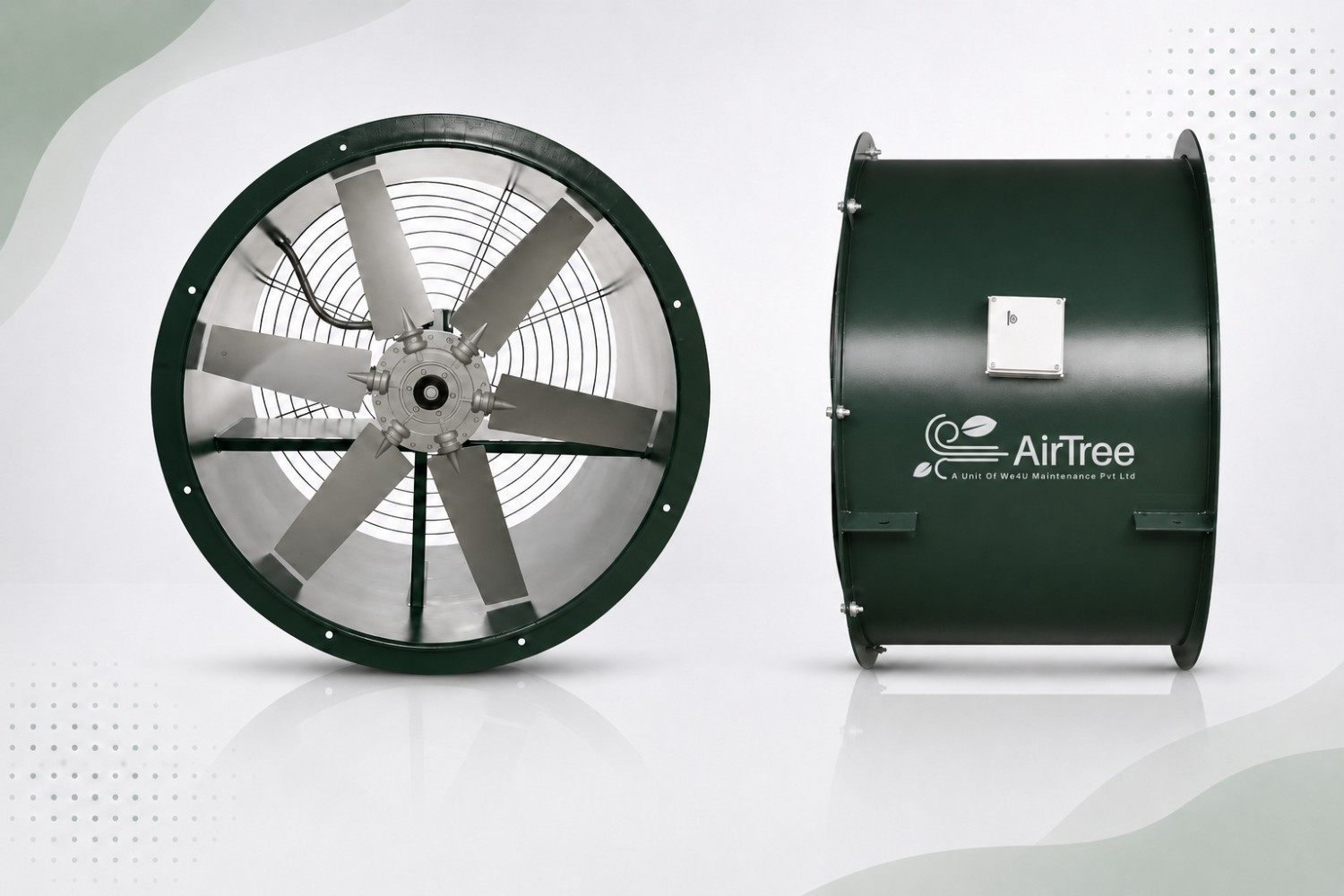
A Tube axial fan is an industrial ventilation device that houses a propeller inside a cylindrical tube, moving large volumes of air along a straight axial path at low pressure. Airtree's tube axial fans deliver 700–40,000 CFM and are used for exhaust, cooling, and air circulation in factories, basements, warehouses, and commercial buildings.
If you've ever stood in a factory, warehouse, or basement parking area and felt a steady rush of moving air, a tube axial fan was likely doing the work. It's one of the most widely used pieces of ventilation equipment in industrial and commercial HVAC systems — simple in design, powerful in performance, and versatile enough to handle everything from exhausting fumes on a factory floor to keeping large basements breathable.
At Airtree, we manufacture tube axial fans engineered for exactly these demands. This guide covers what a tube axial fan is, its core features, the benefits it brings to a ventilation system, where it's commonly used, and answers to the questions people ask most.
What Is a Tube Axial Fan?
A tube axial fan is a type of industrial fan in which a propeller is mounted inside a cylindrical tube or housing, so that air is drawn in and pushed out along the same central axis — hence "axial" flow. This differs from a centrifugal fan, which redirects airflow at a 90-degree angle and is built for higher-pressure, higher-resistance systems.
In short: tube axial fans move a large volume of air with minimal resistance, making them the go-to choice wherever continuous, high-volume airflow matters more than high pressure.
They're often referred to as the backbone of ventilation systems because of how widely they're deployed — anywhere a facility needs to move a lot of air efficiently, without unnecessary mechanical complexity or power draw.
Key Features of a Tube Axial Fan
| Feature | What It Means |
| Airflow Capacity | Airtree tube axial fans range from 700 CFM to 40,000 CFM, covering small workshops to large industrial plants. |
| Construction | Double-skin panel design for added strength, reduced vibration, and durability under continuous-duty use. |
| Pressure Profile | Optimized for low static pressure, high-volume airflow — ideal for open ducts and large spaces. |
| Installation | Compact, in-line, cylindrical housing that mounts directly into ductwork or wall openings, saving floor space. |
| Noise Level | Engineered for low-noise operation even at high airflow rates. |
| Warranty | Backed by a standard 1-year warranty on Airtree units. |
Benefits of Using a Tube Axial Fan
- Efficient air circulation — continuously moves large volumes of air in or out of a space.
- Energy efficiency — low-pressure design typically consumes less power than high-resistance fan systems, lowering long-term operating costs.
- Space-saving design — cylindrical, in-line format fits into tighter mechanical spaces than bulkier fan units.
- Versatility — adapts to factories, basements, commercial buildings, and warehouses alike.
- Better indoor air quality — dilutes pollutants, reduces heat buildup, and clears fumes, dust, or moisture.
- Cost-effective ventilation — simple design means lower upfront and maintenance costs versus complex fan systems.
Common Applications of Tube Axial Fans
Tube axial fans are used across a wide range of industrial and commercial settings, including:
- Industrial facilities & factories — exhausting heat, fumes, dust, and process emissions.
- Basements & underground parking — circulating fresh air and removing vehicle exhaust.
- Commercial buildings — supporting HVAC and fresh air handling systems.
- Warehouses & storage facilities — preventing heat and humidity buildup in large storage areas.
- Mechanical & utility rooms — cooling equipment and preventing heat accumulation around machinery.
- Large open spaces — gymnasiums, workshops, and production floors needing consistent airflow.
Tube axial fans frequently work alongside fresh air treatment units, helping deliver filtered, conditioned air throughout a building — making them a core part of a complete ventilation strategy rather than a standalone accessory.
Tube Axial Fan vs. Centrifugal Fan
| Parameter | Tube Axial Fan | Centrifugal Fan |
| Airflow direction | Straight, in-line (axial) | Redirected at 90° |
| Best for | High volume, low pressure | High pressure, resistance-heavy ducting |
| Installation | Compact, in-line | Larger footprint |
| Common use | Exhaust, general ventilation | Ducted HVAC with filters/coils |
Why Choose Airtree's Tube Axial Fans?
Airtree designs tube axial fans with a clear focus on performance, durability, and energy efficiency:
- Capacities from 700 to 40,000 CFM
- Double-skin construction for strength and vibration control
- Low-noise operation suited to occupied commercial spaces
- 1-year standard warranty
Whether you're setting up ventilation for a new industrial facility, upgrading an aging system, or need a dependable exhaust solution for a commercial space, Airtree's tube axial fans are built for continuous, real-world operation.
Frequently Asked Questions (FAQs)
Q1. What is a tube axial fan used for?
A tube axial fan is used for high-volume, low-pressure ventilation tasks such as exhausting fumes, cooling equipment, and circulating fresh air in factories, basements, warehouses, and commercial buildings.
Q2. What is the difference between a tube axial fan and a centrifugal fan?
A tube axial fan moves air in a straight line along its axis and suits high-volume, low-pressure applications. A centrifugal fan redirects airflow and is better suited to high-pressure systems with more ductwork resistance.
Q3. What CFM range do tube axial fans cover?
Airtree's tube axial fans range from 700 CFM to 40,000 CFM, suitable for both small spaces and large industrial applications.
Q4. Are tube axial fans energy-efficient?
Yes. Because they're designed for low-pressure, high-volume airflow, they generally consume less energy than fans built to overcome high system resistance, which helps reduce long-term operating costs.
Q5. Where are tube axial fans commonly installed?
Common installation points include factory floors, basement and underground parking ventilation, warehouses, mechanical rooms, and commercial building HVAC systems.
Q6. How long do tube axial fans last?
With proper maintenance and durable construction — such as Airtree's double-skin build — tube axial fans are designed for long-term, continuous-duty performance. Airtree units include a 1-year standard warranty.
Q7. Can tube axial fans be used with fresh air treatment systems?
Yes. Tube axial fans are often integrated into fresh air handling setups to help deliver filtered, conditioned air efficiently throughout a building.
Q8. Who manufactures reliable tube axial fans in India?
Airtree, based in Greater Noida, Uttar Pradesh, manufactures industrial-grade tube axial fans along with a full range of HVAC and ventilation equipment including air handling units, fresh air units, and air washers.
Key Takeaways
- A tube axial fan moves air in a straight axial line using an in-line propeller — ideal for high-volume, low-pressure ventilation.
- Airtree's tube axial fans range from 700–40,000 CFM with double-skin construction and low-noise operation.
- Best suited for factories, basements, warehouses, commercial buildings, and mechanical rooms.
- Backed by a 1-year standard warranty and designed for continuous-duty industrial use.
Stay ahead with more industry insights
Join our newsletter to receive the latest HVAC technologies and ventilation solutions directly in your inbox.