What Is a DX Cooling Coil? How It Works, Types and Applications
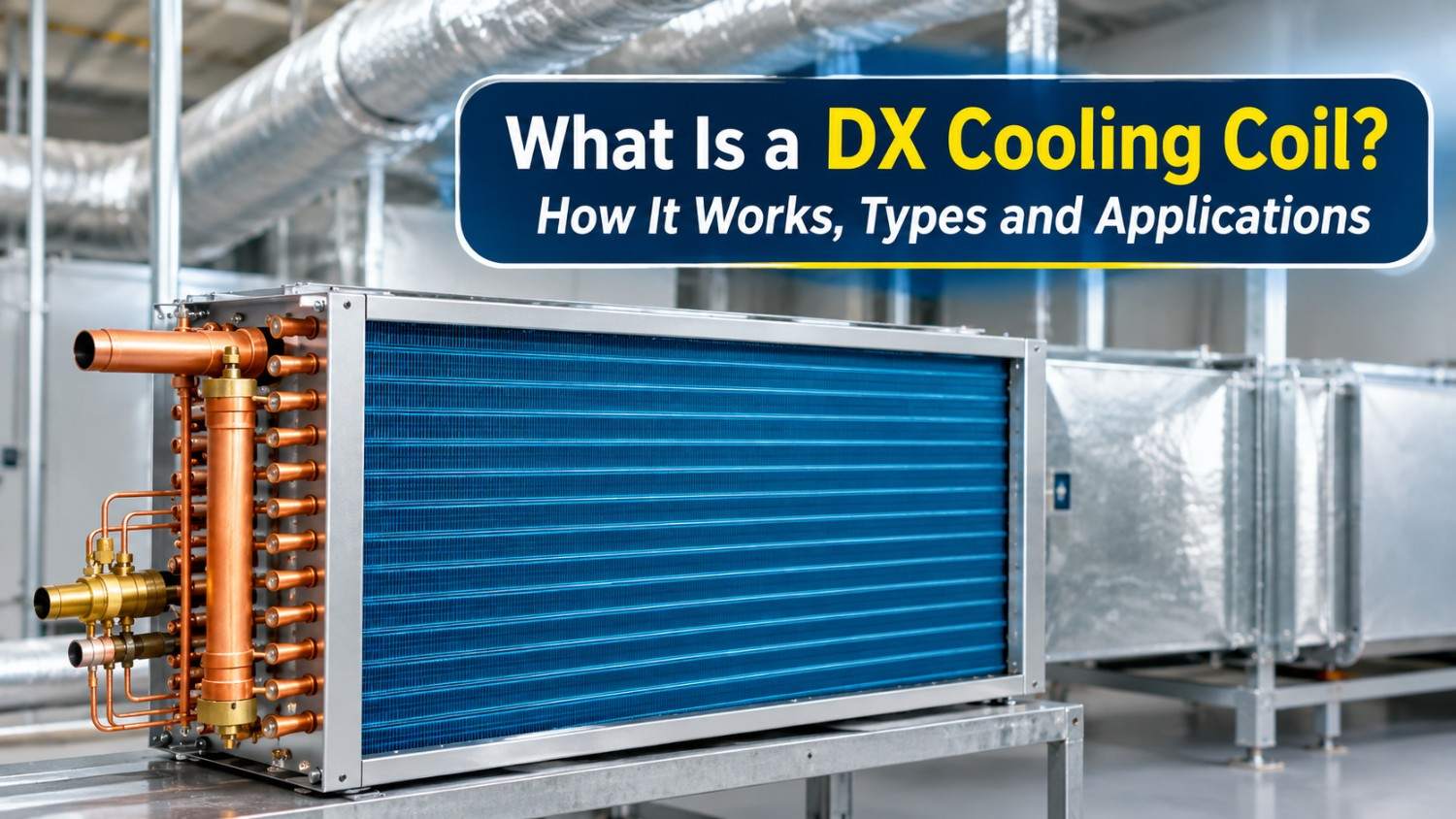
Quick answer: A DX (direct expansion) cooling coil is a heat exchanger in which refrigerant evaporates inside the coil tubes and absorbs heat directly from the air passing over the fins. It needs no intermediate fluid such as chilled water, so it is a compact and efficient cooling solution for air handling units (AHUs), packaged units and split systems.
If you are designing, buying or maintaining an HVAC system, understanding DX coils helps you choose the right cooling technology. This guide explains what a DX cooling coil is, how it works, its main types, where it is used, and how to select one.
What Is a DX (Direct Expansion) Cooling Coil?
A DX cooling coil is the evaporator section of a refrigeration circuit, built as a finned-tube heat exchanger. “Direct expansion” means the refrigerant expands and evaporates directly inside the coil, rather than cooling a secondary fluid first.
Warm air from the room or outdoors is blown across the coil. The refrigerant inside absorbs heat from that air, changes from a low-pressure liquid-vapour mix to a vapour, and cools the air. The coil also removes moisture from the air, which is why DX coils both cool and dehumidify.
Browse our range of Cooling coils and HVAC products to see configurations built for different capacities and applications.
How Does a DX Cooling Coil Work?
A DX coil works as one part of a vapour-compression refrigeration cycle. Here is the process step by step:
- Compression: The compressor raises the pressure and temperature of the refrigerant vapour.
- Condensation: In the condenser, the hot refrigerant rejects heat and becomes a high-pressure liquid.
- Expansion: The liquid passes through an expansion device, such as a thermostatic expansion valve (TXV) or electronic expansion valve (EEV). Its pressure and temperature drop sharply.
- Distribution: A refrigerant distributor splits the flow evenly across the coil circuits.
- Evaporation: Inside the coil tubes, the cold refrigerant absorbs heat from the air and evaporates.
- Return: The low-pressure vapour returns to the compressor, and the cycle repeats.
Sensible and latent cooling: The coil surface runs below the air’s dew point, so water vapour condenses on the fins and drains away. This removes latent heat (humidity) along with sensible heat (temperature), which is important in humid climates.
Main Components of a DX Cooling Coil
- Tubes: Usually copper, carrying the refrigerant.
- Fins: Aluminium or copper plates that increase the heat transfer surface area. Fin density is measured in fins per inch (FPI).
- Headers and return bends: Connect the tubes into circuits.
- Distributor: Feeds refrigerant evenly to every circuit. Poor distribution lowers capacity and can cause icing.
- Expansion valve (TXV/EEV): Controls refrigerant flow based on superheat.
- Casing and drain pan: Support the coil and collect condensate.
Types of DX Cooling Coils
By construction
- Copper tube, aluminium fin: The most common option. It is cost-effective and performs well in general comfort applications.
- Copper tube, copper fin: Better corrosion resistance. It suits coastal, industrial or chemically aggressive environments.
- Coated or epoxy-coated coils: A protective layer extends coil life in corrosive conditions.
By circuiting
- Full circuit: One refrigerant circuit serves the whole coil. It is simple and suits steady loads.
- Split or face-split circuit: Separate circuits serve different parts of the face. This gives better part-load performance and humidity control.
- Row-split / interlaced circuit: Circuits are interleaved so that even at part load, refrigerant contacts the full airflow. This improves coil utilisation and reduces freeze-up risk.
By application
- Comfort cooling coils: For offices, malls and hotels.
- Process and precision cooling coils: For data centers, labs and manufacturing.
- Dehumidification coils: Designed for deep cooling and tight humidity control.
For custom configurations, see our product catalogue.
Applications of DX Cooling Coils
DX coils are used wherever a compact, self-contained cooling solution is needed:
- Air handling units (AHUs) and packaged units in commercial buildings
- Cleanrooms and pharmaceutical facilities needing precise temperature and humidity control
- Data centers and server rooms requiring reliable, continuous cooling
- Cold storage and food processing facilities
- Hospitals, hotels, malls and offices
- Industrial process cooling and dehumidification
DX Coil vs Chilled Water Coil
| Feature | DX Coil | Chilled Water Coil |
| Cooling medium | Refrigerant (evaporates in coil) | Chilled water |
| System complexity | Simpler, no chiller plant | Needs chiller, pumps, piping |
| Best for | Small to medium capacity | Large buildings, high capacity |
| Temperature control | Staged or variable compressor control | Valve modulation, very precise |
| Installation cost | Generally lower for small systems | Higher upfront, efficient at scale |
| Refrigerant charge | Large charge in the coil circuit | Minimal in the coil |
Rule of thumb: DX is usually the better fit for small to medium loads and standalone systems. Chilled water tends to win in large central plants.
Advantages and Limitations
Advantages
- Compact and fast to install
- High heat transfer efficiency, since there is no secondary fluid loop
- Lower first cost for small and medium systems
- Good dehumidification performance
Limitations
- Needs careful refrigerant distribution and control
- Risk of freezing if airflow is low or the coil is dirty
- Refrigerant leaks and charge limits need attention
- Less suited to very large capacities
How to Select the Right DX Cooling Coil
Check these factors before buying:
- Cooling capacity (TR or kW) and the sensible heat ratio (SHR)
- Air flow and face velocity, to avoid moisture carryover
- Fin density (FPI) and the pressure drop it creates
- Refrigerant type, such as R410A, R32 or R454B, and compatibility with your system
- Circuiting for part-load control
- Material and coating, based on environment and air quality
- Operating conditions, including entering air temperature and humidity (for India, design for local high-humidity conditions)
Not sure what to specify? Visit the Airtree HVAC homepage to contact our team, or view our range.
Key Takeaways
- A DX cooling coil cools air by evaporating refrigerant directly inside its tubes.
- It combines sensible cooling and dehumidification in one component.
- Material, circuiting and fin density should match the application and environment.
- DX suits small to medium systems, while chilled water suits large central plants.
Frequently Asked Questions
1. What does DX mean in a DX cooling coil?
DX stands for direct expansion. The refrigerant expands and evaporates directly inside the coil to cool the air.
2. Is a DX coil the same as an evaporator coil?
Yes. In a refrigeration circuit, a DX coil is the evaporator coil. The term “DX” highlights that refrigerant, not water, is used.
3. What is the difference between a DX coil and a chilled water coil?
A DX coil uses evaporating refrigerant. A chilled water coil uses water cooled by a separate chiller.
4. Why does a DX coil freeze up?
Common causes are low airflow, a dirty coil or filter, low refrigerant charge, or faulty expansion valve control.
5. Which refrigerants are used in DX coils?
Common options include R410A, R32 and R454B, depending on the system design and regulations.
6. Where are DX cooling coils used?
They are used in AHUs, cleanrooms, data centers, cold storage, hospitals, hotels and commercial buildings.
Stay ahead with more industry insights
Join our newsletter to receive the latest HVAC technologies and ventilation solutions directly in your inbox.