Air Handling Unit Filter Types : A Complete Guide
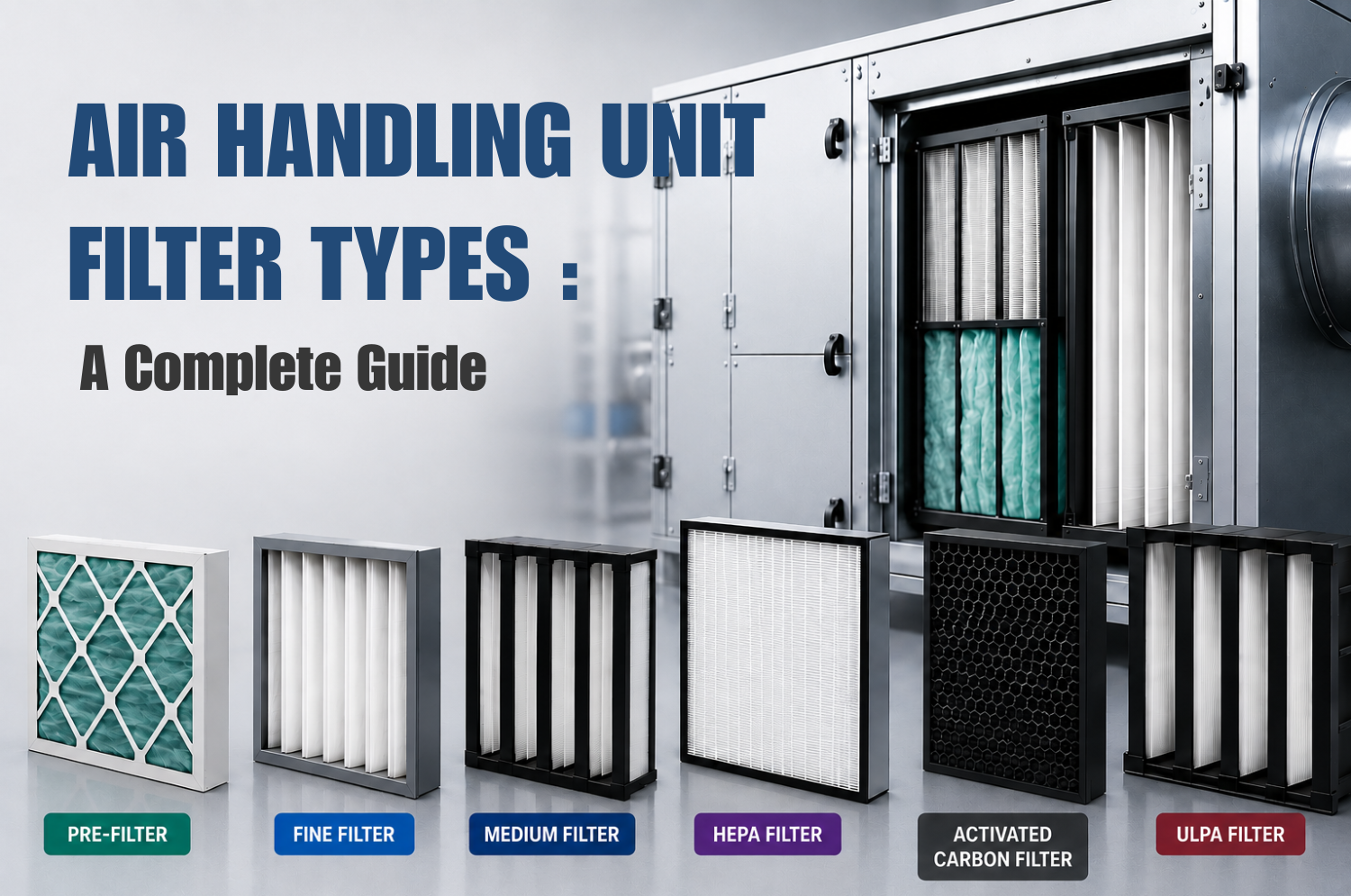
Filtration is one of the most important functions built into every Air Handling Unit (AHU). While fans, coils, and dampers control airflow and temperature, it is the filter section that determines the quality of air being delivered into a building. Choosing the right combination of AHU filter types is essential for maintaining indoor air quality, protecting sensitive equipment, and meeting the hygiene standards required in hospitals, pharmaceutical plants, food processing units, and commercial spaces.
Not all filters are built the same, and not every application needs the same level of filtration. This guide breaks down the different types of filters used in an AHU, how they work, where they are typically applied, and how to choose the right filter combination for your facility.
Why Filter Type Selection Matters
An Air Handling Unit AHU rarely relies on a single filter to do all the work. Instead, most systems use a staged filtration approach — starting with coarse filters that remove large particles, followed by progressively finer filters that capture smaller contaminants. This layered design protects the more expensive, high-efficiency filters from clogging too quickly, extends their service life, and ensures consistent air quality.
Selecting the wrong filter type — or skipping a filtration stage — can lead to premature clogging, poor indoor air quality, higher energy consumption, and even contamination risks in critical environments like operation theatres or cleanrooms. Understanding the different types of filters used in AHUs helps facility managers and HVAC engineers design a filtration strategy suited to their specific environment.
Classification of Air Handling Unit (AHU) Filters
Filters used in Air Handling Units are generally classified based on their efficiency rating, which is measured using standards such as ISO 16890, EN 779, or MERV (Minimum Efficiency Reporting Value). Broadly, AHU filter types fall into four categories: pre-filters, fine filters, HEPA/ULPA filters, and specialty filters such as activated carbon.
1. Pre-Filters (Coarse Filters)
Pre-filters are the first line of defense in an AHU's filtration system. They are designed to capture large airborne particles such as dust, lint, insects, hair, and other coarse debris before air moves further into the unit.
Key characteristics:
- Typically rated G1 to G4 (EN 779) or MERV 1–4
- Low resistance to airflow, meaning minimal energy penalty
- Washable or disposable, depending on construction
- Commonly made from synthetic fiber, foam, or metal mesh
Common applications: General commercial buildings, warehouses, and as the first stage in almost every AHU, regardless of the building type.
Pre-filters primarily protect the downstream, more expensive fine filters from premature clogging. Because they handle the bulk of the particulate load, they typically require the most frequent cleaning or replacement.
2. Fine Filters (Medium-Efficiency Filters)
After pre-filtration, air passes through fine filters, which capture smaller particles such as pollen, mold spores, and fine dust that pre-filters cannot trap.
Key characteristics:
- Rated F5 to F9 (EN 779) or MERV 8–13
- Higher resistance to airflow compared to pre-filters
- Usually constructed as pleated panels or bag filters to maximize surface area
- Common materials include synthetic microfiber and glass fiber media
Common applications: Offices, hotels, retail spaces, schools, and general commercial HVAC systems where moderate indoor air quality standards apply.
Fine filters strike a balance between filtration performance and airflow resistance, making them the standard choice for most commercial AHU installations.
3. HEPA Filters (High-Efficiency Particulate Air)
HEPA filters represent one of the highest levels of filtration commonly used in AHUs. They are capable of capturing extremely small particles, including bacteria and some viruses, making them essential in environments where air purity is critical.
Key characteristics:
- Capture at least 99.97% of particles as small as 0.3 microns
- Rated H13–H14 under EN 1822 standards
- High resistance to airflow, requiring more powerful fans
- Constructed from dense, pleated glass fiber media
Common applications: Hospitals, operation theatres, pharmaceutical manufacturing, cleanrooms, laboratories, and semiconductor facilities.
Because of their fine pore structure, HEPA filters are almost always installed as a final stage, protected by pre-filters and fine filters upstream to prevent premature clogging.
4. ULPA Filters (Ultra-Low Penetration Air)
ULPA filters go a step beyond HEPA, offering even higher filtration efficiency for the most sensitive environments.
Key characteristics:
- Capture at least 99.999% of particles as small as 0.12 microns
- Extremely high airflow resistance
- Used only where absolute air purity is non-negotiable
Common applications: Semiconductor cleanrooms, biosafety laboratories, and specialized pharmaceutical production areas requiring the strictest contamination control.
5. Activated Carbon Filters
Unlike particulate filters, activated carbon filters target gaseous pollutants, odors, and volatile organic compounds (VOCs) rather than solid particles.
Key characteristics:
- Uses adsorption to trap gas molecules within a porous carbon structure
- Does not typically capture fine dust or particulates on its own
- Often combined with particulate filters for comprehensive air treatment
Common applications: Facilities near industrial pollution sources, laboratories handling chemicals, commercial kitchens, and buildings requiring odor control.
6. Electrostatic Filters
Electrostatic filters use an electrical charge to attract and trap airborne particles, offering an alternative to purely mechanical filtration.
Key characteristics:
- Can be washable and reusable, reducing long-term replacement costs
- Effective at capturing small particles with relatively low airflow resistance
- Efficiency can decline over time if not cleaned regularly
Common applications: Buildings looking for a balance between filtration performance and lower operating costs, including some residential and light commercial systems.
7. Bag Filters
Bag filters, sometimes categorized under fine filters, deserve a specific mention due to their widespread use in AHUs. Their pocket-style design increases surface area significantly compared to flat panel filters.
Key characteristics:
- Multiple fabric pockets extend filter life and reduce pressure drop
- Available across a range of efficiency ratings, from medium to high efficiency
- Commonly used as the second stage after pre-filters
Common applications: Commercial buildings, hospitals (as a pre-HEPA stage), and industrial facilities requiring extended filter life between replacements.
Comparing AHU Filter Types
| Filter Type | Efficiency Range | Airflow Resistance | Typical Use Case |
| Pre-Filter | G1–G4 / MERV 1–4 | Low | General dust, first-stage protection |
| Fine Filter | F5–F9 / MERV 8–13 | Medium | Offices, hotels, commercial spaces |
| HEPA Filter | H13–H14 | High | Hospitals, cleanrooms, pharma |
| ULPA Filter | 99.999% @ 0.12 microns | Very High | Semiconductor, biosafety labs |
| Activated Carbon | Gas/odor adsorption | Medium | Odor and VOC control |
| Electrostatic | Varies | Low–Medium | Reusable, cost-conscious systems |
| Bag Filter | F5–F9 typically | Medium | Extended-life second-stage filtration |
How to Choose the Right Filter Type for Your AHU
Selecting the correct combination of filters depends on several factors specific to the building and its use:
- Indoor air quality requirements: Hospitals and cleanrooms require HEPA or ULPA filtration, while offices may only need fine filters.
- Outdoor air pollution levels: Facilities in high-pollution or industrial areas benefit from stronger pre-filtration to reduce the load on downstream filters.
- Regulatory and compliance standards: Pharmaceutical and food processing facilities often must meet specific filtration standards set by regulatory bodies.
- Energy efficiency goals: Higher-efficiency filters increase airflow resistance, which can raise fan energy consumption. Balancing filtration needs with energy costs is essential.
- Maintenance capacity: Washable and electrostatic filters reduce replacement frequency but require more hands-on cleaning schedules.
In most well-designed AHUs, a layered approach — pre-filter, fine filter, and where needed, HEPA — offers the best combination of protection, efficiency, and cost-effectiveness.
Maintenance Considerations Across Filter Types
Regardless of the filter type installed, regular inspection and timely replacement or cleaning are critical to maintaining performance. Pre-filters typically need attention every few weeks, fine filters every one to three months, and HEPA filters less frequently but with careful handling during replacement to avoid damaging the delicate media. Monitoring static pressure across each filter stage is one of the most reliable ways to determine when a filter needs servicing, regardless of its type.
Conclusion
Understanding the different types of filters used in an Air Handling Unit is the first step toward building an effective, efficient, and reliable filtration strategy. From basic pre-filters that catch large debris to HEPA and ULPA filters that protect the most sensitive environments, each filter type plays a specific role in a layered defense against airborne contaminants.
Choosing the right combination depends on the building's function, air quality requirements, and budget for ongoing maintenance. A well-designed filtration system not only improves indoor air quality but also protects the AHU itself from unnecessary wear, reducing long-term operating costs.
AirTree HVAC designs and manufactures Air Handling Units engineered for flexible, multi-stage filtration — from standard commercial buildings to hospitals, pharmaceutical facilities, and cleanrooms. With a focus on durable construction and application-specific filter configurations, AirTree helps businesses maintain clean, healthy, and efficient air systems tailored to their exact requirements.
Stay ahead with more industry insights
Join our newsletter to receive the latest HVAC technologies and ventilation solutions directly in your inbox.