DX Coil vs Chilled Water Coil: Which Is Right for Your HVAC System?
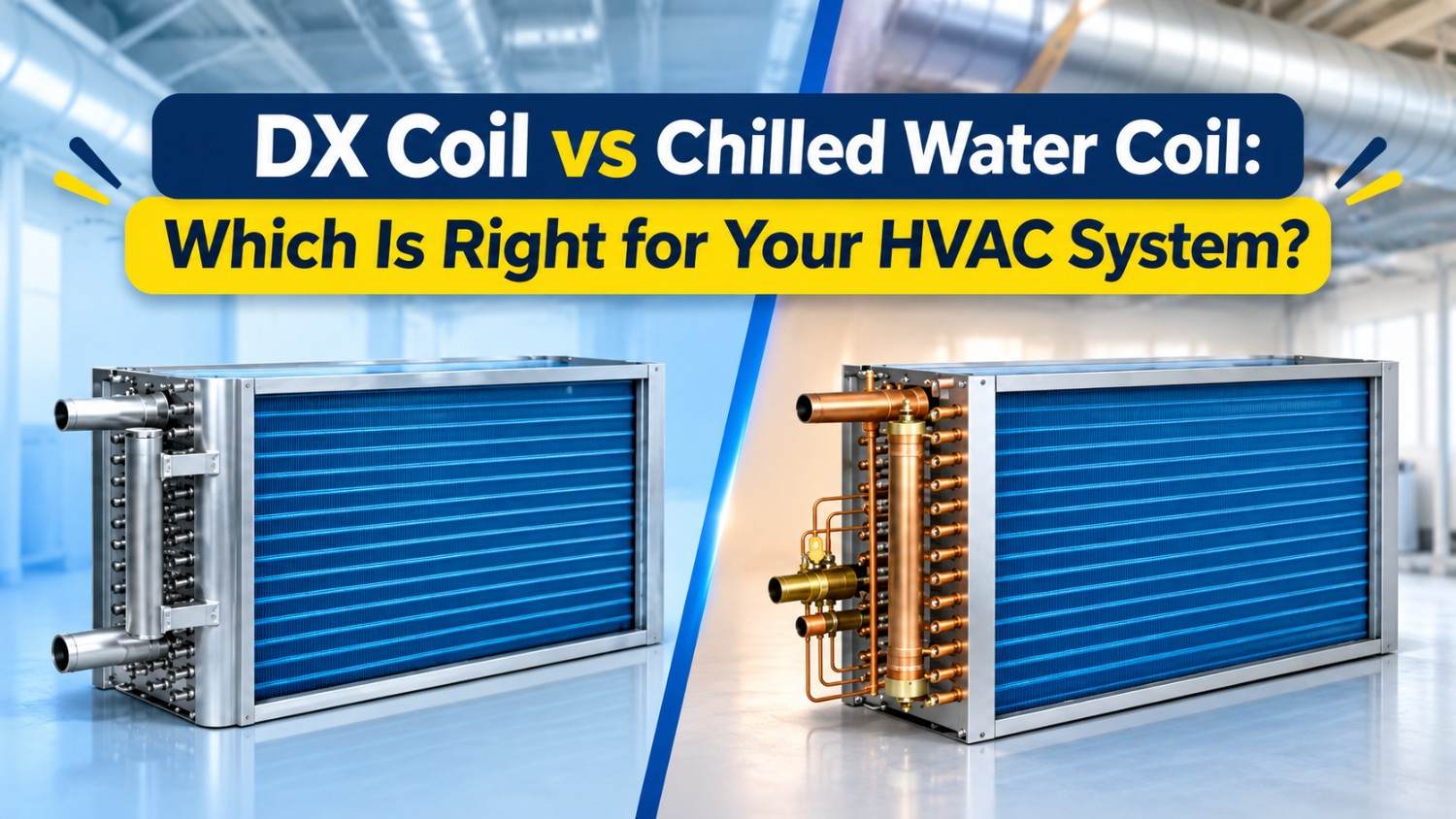
Quick answer: A DX (direct expansion) coil cools air by evaporating refrigerant directly inside its tubes. A chilled water coil cools air using water that a separate chiller has already cooled. DX coils suit small to medium loads and standalone systems with lower upfront cost. Chilled water coils suit large buildings and central plants where precise control and high capacity matter most.
Choosing between the two is one of the most important decisions in HVAC design. It affects first cost, running cost, space, control accuracy and maintenance for years. This guide compares both options side by side so you can decide with confidence.
New to the basics? Read our pillar guide, What Is a DX Cooling Coil?, before continuing.
What Is a DX Coil?
A DX coil is a finned-tube heat exchanger in which refrigerant expands and evaporates inside the tubes. The refrigerant absorbs heat directly from the air blowing across the fins. There is no intermediate fluid, which makes the system compact and thermally efficient. DX coils are typically paired with a compressor and condenser in packaged units, split systems and air handling units (AHUs).
Explore our DX cooling coil range for available capacities and configurations.
What Is a Chilled Water Coil?
A chilled water coil is also a finned-tube heat exchanger, but its tubes carry chilled water, typically supplied at 6 to 7°C and returning at 11 to 13°C. A central chiller cools the water, and pumps circulate it through piping to the coils in each air handler or fan coil unit. The coil cools the air by transferring heat into the water, which then returns to the chiller.
How Each Coil Works
DX coil process
- The compressor pressurises the refrigerant.
- The condenser rejects heat, turning the refrigerant into a liquid.
- An expansion valve drops its pressure and temperature.
- The cold refrigerant evaporates inside the coil, absorbing heat from the air.
- The vapour returns to the compressor.
Chilled water coil process
- The chiller cools water to the design supply temperature.
- Pumps send the chilled water through piping to the coil.
- Air passes over the coil, and the water absorbs its heat.
- A control valve modulates water flow to match the load.
- Warmer water returns to the chiller to be cooled again.
DX Coil vs Chilled Water Coil: Side-by-Side Comparison
| Parameter | DX Coil | Chilled Water Coil |
| Cooling medium | Refrigerant (evaporates in coil) | Chilled water from a chiller |
| Typical capacity | Small to medium | Medium to very large |
| System components | Compressor, condenser, expansion valve | Chiller, pumps, piping, control valves |
| Upfront cost | Lower for small systems | Higher, due to the central plant |
| Energy efficiency | Good at small scale | Better at large scale and part load |
| Temperature control | Compressor staging or inverter control | Very precise valve modulation |
| Humidity control | Good, but needs circuiting care | Excellent with proper valve control |
| Installation | Faster, fewer components | Longer, more piping and commissioning |
| Refrigerant charge | Large charge in the coil circuit | Minimal in the coil |
| Freeze-up risk | Higher if airflow or charge is wrong | Lower, can use glycol if needed |
| Maintenance | Refrigerant checks, leak testing | Water treatment, pump and valve upkeep |
| Best for | Standalone units, small to mid buildings | Large buildings, campuses, central plants |
Advantages and Limitations
DX coil
Advantages
- Lower first cost for small and medium systems
- Compact, with no chiller plant or water piping
- Fast installation and commissioning
- Direct heat transfer with no secondary loop losses
Limitations
- Harder to scale to very large capacities
- Needs careful refrigerant distribution and circuiting
- Greater refrigerant leak and charge-limit concerns
- Part-load control depends on compressor staging or variable speed
Chilled water coil
Advantages
- Scales easily across many zones from one central plant
- Smooth, precise control through valve modulation
- Low refrigerant risk at the coil
- Efficient at large scale and across varying loads
Limitations
- Higher upfront cost and space for chillers, pumps and piping
- Ongoing water treatment and pump maintenance
- Risk of water leaks and condensation on piping
- Longer installation time
Cost Comparison: Which Is More Economical?
- Small and medium projects: DX usually wins on total cost, because you avoid the chiller plant, pumps and piping.
- Large projects: Chilled water often wins over the lifecycle. A central chiller is more efficient than many small compressors, and one plant serves many zones.
- Break-even: As a rough guide, many designers look at chilled water once the load reaches a few hundred TR or when many zones share one plant. Treat this as a starting point and confirm with a lifecycle cost analysis for your project.
Applications: Where Each Coil Fits Best
Choose a DX coil for:
- Packaged units and standalone AHUs
- Small offices, retail shops, restaurants and clinics
- Server rooms and small data centers
- Cold storage and food processing rooms
- Sites with no chilled water plant
Choose a chilled water coil for:
- Large commercial towers, malls and airports
- Hospitals and campuses with many zones
- Large data centers with central cooling plants
- Industrial facilities with a district or central chilled water supply
Either can work for: Cleanrooms and pharma facilities. Choose based on required precision, available utilities and plant size.
How to Choose: 7 Questions to Ask
1. What is the total cooling load?
Small to medium points to DX. Large points to chilled water.
2. How many zones need cooling?
Many zones favour a central chilled water plant.
3. Is a chilled water plant already available?
If yes, a chilled water coil is usually cheaper to add.
4. How tight is the temperature and humidity control?
Both can deliver, but chilled water offers smoother modulation.
5. What is your budget profile?
Lower capex favours DX. Lower lifecycle cost at scale favours chilled water.
6. What are the refrigerant regulations and charge limits?
Large DX charges may need extra safety measures.
7. What local climate do you design for?
In hot and humid regions such as most of India, size the coil for high latent load either way.
Need help deciding? Contact the Airtree HVAC team or view our Coil products to discuss your project.
Key Takeaways
- DX coils cool with evaporating refrigerant. Chilled water coils cool with water from a chiller.
- DX is simpler and cheaper for small to medium loads.
- Chilled water is better for large, multi-zone buildings and central plants.
- Control needs, budget, available utilities and project size should drive the decision.
Frequently Asked Questions
1. What is the main difference between a DX coil and a chilled water coil?
A DX coil uses refrigerant that evaporates directly in the coil. A chilled water coil uses water cooled by a separate chiller.
2. Which is more energy efficient, DX or chilled water?
DX is efficient for small systems. Chilled water is usually more efficient for large systems and varying loads because central chillers are more efficient at scale.
3. Is a DX coil cheaper than a chilled water coil?
For small to medium projects, usually yes. DX avoids the chiller, pumps and piping, which lowers the first cost.
4. Can a DX coil be used in an AHU?
Yes. DX coils are widely used in AHUs and packaged units for commercial and industrial buildings.
5. Which coil gives better humidity control?
Both can dehumidify. Chilled water offers smoother modulation, while DX needs correct circuiting to control humidity at part load.
6. Which coil is better for hot and humid climates?
Either works if sized for the latent load. Choose based on project size, available plant and control needs.
Stay ahead with more industry insights
Join our newsletter to receive the latest HVAC technologies and ventilation solutions directly in your inbox.