Winter Smog in Delhi NCR: How Fresh Air Units and Filtration Improve Indoor Air Quality
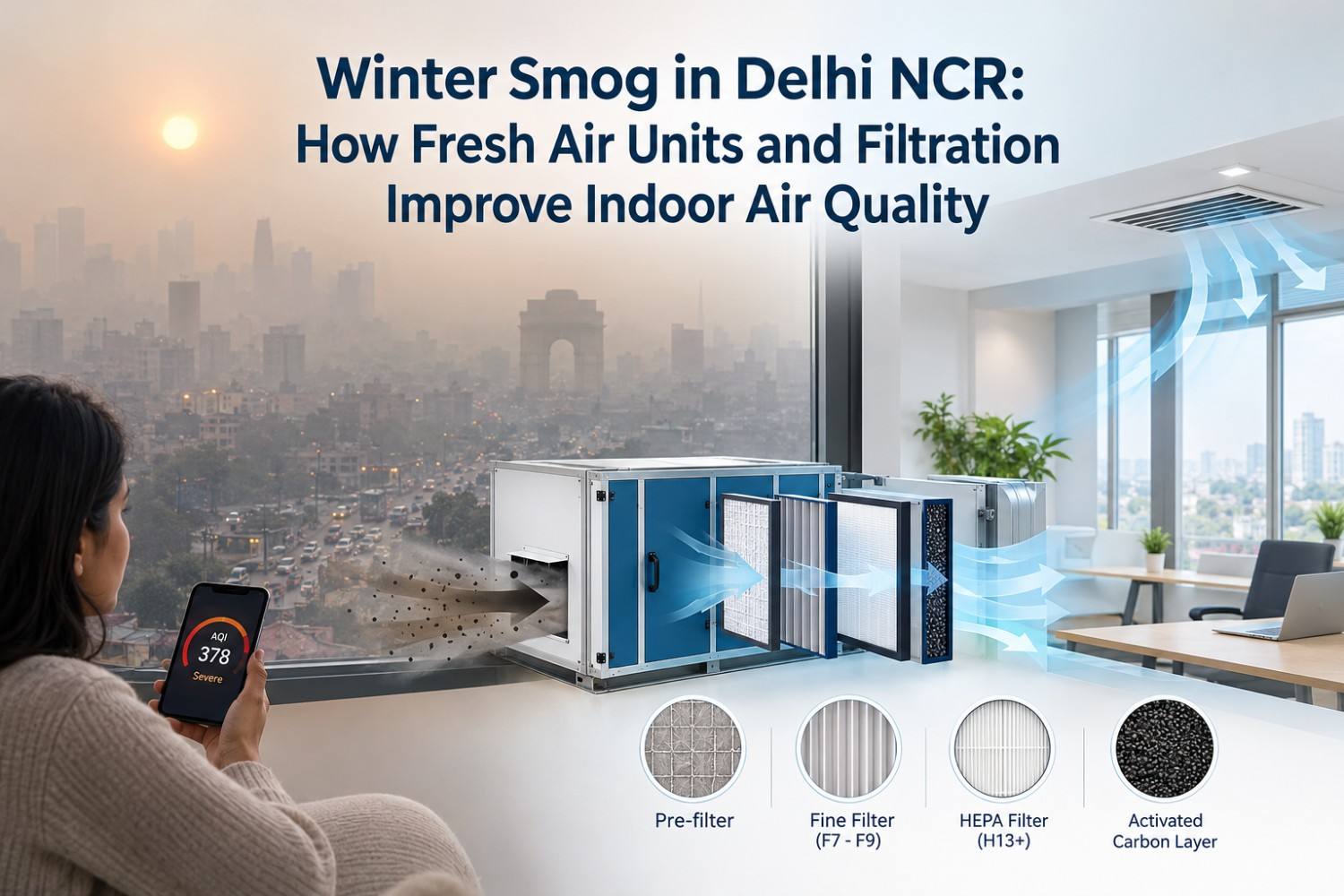
A fresh air unit is a ventilation system that draws outdoor air through filters, treats it and supplies it to a building at a controlled rate while stale air is exhausted. In smog season, it keeps PM2.5 out and CO2 down without opening windows.
Around the last week of October, Delhi NCR changes. The sun looks pale by late afternoon, the air smells faintly of smoke, and the AQI app becomes the first thing people check in the morning. Most offices and households respond the same way: shut the windows, switch on a purifier, and wait for the wind to turn.
That helps, but it is only half a plan. A sealed room with no fresh air brings its own problems, from stuffy meeting rooms to heavy-headed afternoons. This guide explains why winter smog in Delhi NCR gets indoors, what actually cleans the air you breathe, and how fresh air units and filtration work together.
Why Delhi NCR Smog Peaks in Winter
The region does not suddenly produce more pollution in November. The weather just stops clearing it. Cold nights and weak winds create a temperature inversion, a layer of warm air sitting over cooler air near the ground, which works like a lid. Vehicle exhaust, construction dust, industrial emissions, waste burning and smoke from crop residue fires in neighbouring states all collect underneath it.
The pollutant to watch is PM2.5: particles under 2.5 microns, roughly thirty times thinner than a human hair. They slip past the nose and throat and settle deep in the lungs. India's national standard allows a 24-hour average of 60 µg/m³ for PM2.5, while the World Health Organization recommends a much stricter 15 µg/m³. On bad days, NCR readings run well past both.
Why Your Indoor Air Is Not as Clean as You Think
It is easy to assume indoor air is safer. During smog season that is only partly true. Outdoor air leaks in through door frames, window tracks, balcony sliders and the gaps around AC sleeves and pipe cut-outs. Indoor PM2.5 usually follows the outdoor reading with a delay of a few hours.
Then there is what we add ourselves: cooking fumes, incense, cleaning sprays, dust from carpets and the carbon dioxide every person breathes out. In a closed office or bedroom, CO2 builds up quickly. Many ventilation guidelines treat a sustained level above roughly 1,000 ppm as a sign of under-ventilation. People feel it as a heavy head and poor focus, then blame the smog.
So the goal has two parts: keep polluted air out, and keep fresh air coming in.
What a Fresh Air Unit Does
A fresh air unit draws outdoor air through filters, treats it and supplies it to the building at a controlled rate, while stale air leaves through a separate exhaust path. In larger buildings this job usually goes to a treated fresh air unit, which cools, heats, dehumidifies and filters 100% outside air before it reaches occupied rooms. Airtree's Treated Fresh Air Unit is built for exactly this.
Three things change once one is running:
- Pollutants get diluted. Fresh, filtered air replaces air loaded with CO2, moisture, odours and cooking particles.
- The building stays slightly pressurised. When a little more air is supplied than leaves, air pushes outward through gaps instead of pulling unfiltered smog in.
- Windows stay shut. You get ventilation without inviting the smog inside.
Many setups also add a heat recovery unit, which passes heat between outgoing and incoming air. That cuts the load on your cooling and heating.
Filtration: The Part That Does the Real Work
A fresh air unit is only as good as the filters inside it. Good systems clean air in stages.
- Pre-filter. Catches coarse dust, hair, insects and pollen, and protects everything behind it.
- Fine filter (F7 to F9 class). Captures most PM10 and a useful share of PM2.5.
- HEPA filter (H13 or higher). Removes at least 99.95% of particles at the most penetrating size, which is why it is the usual benchmark for smog-grade cleaning.
- Activated carbon layer. Adsorbs smoke smell and some gases, including VOCs.
Two practical points. First, filters clog faster in smog months, so follow the replacement schedule and inspect them more often between October and February. A clean cooling coil matters as well, and our guide on cleaning an AHU cooling coil without damaging the fins shows how.
Second, a filter only works when air is forced through it. Poorly sealed housings let air slip around the media, so installation quality counts as much as the filter grade. The casing matters too. Double-skin panels, like those on Airtree's Double Skin Fresh Air Unit, add insulation and keep noise down.
Fresh Air Unit vs Air Purifier: Which Do You Need?
The two are often treated as rivals, but they solve different problems.
A standalone air purifier recirculates and cleans the air already in the room. It is portable and good at removing particles. It cannot lower CO2 or bring in outside air.
A fresh air unit ventilates the whole space and filters what enters. It is a fixed installation, but it fixes the stuffiness a closed-window winter creates.
For most NCR buildings, a sensible plan is a fresh air unit for baseline ventilation and filtration, with portable purifiers as a boost in rooms that need it, such as a clinic waiting area or a nursery. If you are weighing larger systems, our comparison of AHU vs FCU explains where each one fits.
A Smog-Season Checklist for Any Building
These habits help whether or not you have a system installed:
- Check the AQI before opening a window, and air the building out when readings dip, usually mid-afternoon.
- Seal gaps with weatherstripping and door sweeps.
- Run the kitchen exhaust while cooking and skip incense in closed rooms.
- Keep a CO2 and PM2.5 monitor where people spend long hours.
- Service filters before the season starts, not halfway through it.
Where Airtree Fits In
Airtree is an HVAC and ventilation manufacturer based in Greater Noida, supplying projects across Delhi, Noida, Gurugram, Ghaziabad and Faridabad. The range covers treated fresh air units, air handling units, heat recovery units and cooling coils, all made in-house.
For offices, hospitals, malls, hotels and premium residential buildings, the team can study your floor plan, occupancy and fresh air requirement, then specify unit size and filter stages to match. Planning now, before the heaviest weeks in November, leaves time to size the system and schedule installation properly. You can browse the full products catalogue, look at the air ventilation and cooling systems, or get a quote.
Frequently Asked Questions
Does winter smog affect indoor air quality?
Yes. Outdoor PM2.5 enters through gaps in doors and windows, and indoor levels usually rise a few hours after outdoor levels do.
Can a fresh air unit remove PM2.5?
Yes, when it has fine and HEPA-grade filters. Incoming air passes through them before it reaches the rooms.
Is a fresh air unit better than an air purifier?
They do different jobs. Purifiers clean recirculated air. Fresh air units bring in filtered outdoor air and expel stale air, which also controls CO2. Many buildings use both.
How often should filters be changed in Delhi NCR?
It depends on the filter type and usage, but smog season shortens filter life. Follow the maker's schedule and inspect filters more often between October and February.
Is it safe to keep windows closed all winter?
Closed windows keep smog out, but without mechanical ventilation, CO2 and moisture build up. A fresh air unit solves that.
Keep reading: browse the Airtree blog or the Knowledge Hub for more on ventilation and indoor air.
Stay ahead with more industry insights
Join our newsletter to receive the latest HVAC technologies and ventilation solutions directly in your inbox.